Suspended ceiling with LED lighting: types, labour cost and examples
The types of suspended ceiling, what the labour costs and a worked example for a 16 m² room with LED strip and downlights – plus what to decide first.
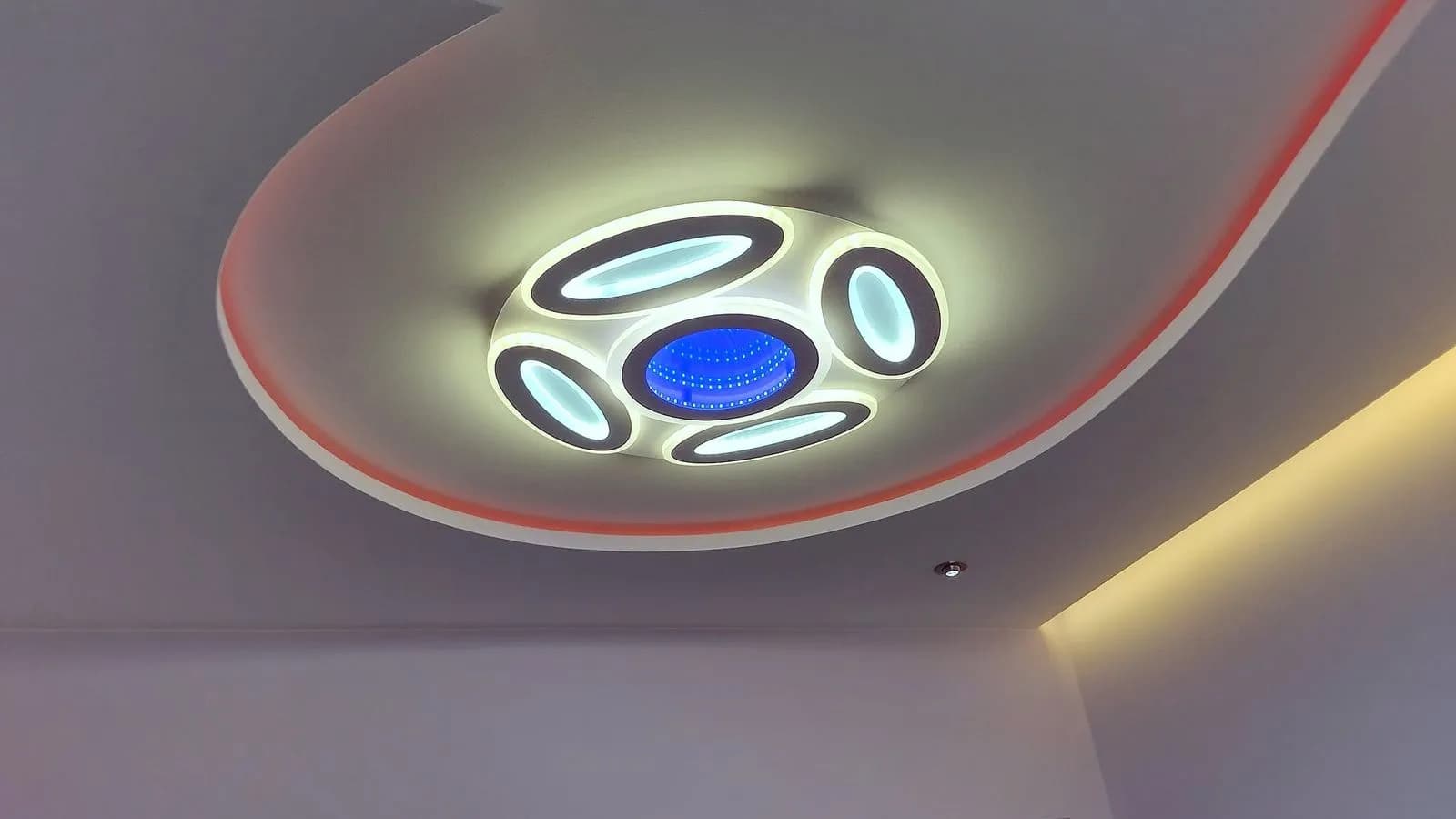
Labour for a suspended (dropped) plasterboard ceiling starts at €18.79 per m² for a simple single-level ceiling. A two-level ceiling with concealed lighting costs exactly twice as much – €37.58 per m² for labour. For the LED strip, labour is €13.42 per linear metre for fitting it, plus €8.05 per metre for its wiring.
For a 16 m² room with a two-level ceiling, 16 linear metres of LED strip and six downlights, labour comes to €1,057.54, or €1,504.26 with the jointing, skim coat and paint on the ceiling. Materials are not included in these amounts: the profiles and the plasterboard are a separate line in our quote, and the price of the strip, the power supply and the light fittings depends on what you choose.
Prices are as of October 2026 and may change – the current ones are in the price list. The photos in this article are from our own projects.
Labour prices: the ceiling and the lighting
| Work | Labour price |
|---|---|
| Installing a suspended plasterboard ceiling | €18.79 per m² |
| Installing a suspended plasterboard ceiling (concealed lighting) | €18.79 per m² |
| Installing a suspended ceiling + mineral wool | €24.16 per m² |
| Installing a suspended ceiling on a double frame + mineral wool | €28.45 per m² |
| Installing a suspended ceiling + mineral wool / under the roof | €35.00 per m² |
| Installing a two-level suspended plasterboard ceiling with concealed lighting | €37.58 per m² |
| Building a frame along the walls for concealed lighting | €22.55 per lin. m |
| Building ceiling bulkheads (coving boxes) + concealed lighting | €30.68 per lin. m |
| Plasterboard shapes and curved forms | on quote |
| Installing a stretch ceiling + lighting | €69.79 per m² |
| Grid ceiling | €21.47 per m² |
| Plasterboard suspended ceiling (bathroom/toilet) | €161.06 each |
| Fitting an LED strip | €13.42 per lin. m |
| Running the wiring for an LED strip | €8.05 per lin. m |
| Running the wiring for downlights | €8.05 each |
| Fitting downlights | €10.74 each |
| Fitting an access panel | €42.95 each |
| Jointing plasterboard + mesh | €5.37 per m² |
| Primer before skim coat, 2 coats of skim, sanding, dust removal, primer before paint, 2 coats of paint | €22.55 per m² |
| Removing a suspended plasterboard ceiling | €10.74 per m² |
Types of suspended ceiling and what each one offers
A suspended plasterboard ceiling is mounted on a metal frame fixed below the concrete slab or below the roof. The types differ in what goes above the boards, in the number of levels and in shape; stretch ceilings and grid ceilings are a separate category. Here we cover the practical differences; for design ideas, see the articles on luxury suspended ceilings and on plasterboard and suspended ceilings in modern interiors.
A simple single-level ceiling
This is the cheapest suspended ceiling – €18.79 per m² for labour. It gives you a new, flat surface whatever the state of the old slab, and it hides cables, pipes, cracks and unevenness. Downlights can be fitted wherever they are needed.
The item ‘Installing a suspended plasterboard ceiling (concealed lighting)’ has the same labour price; the strip and its wiring are charged separately. If the old ceiling is sound and you only want it white and flat, a suspended ceiling is not a must – sometimes a skim coat and paint applied directly to the slab are enough (€22.55 per m² for labour).
With mineral wool: warmer and quieter
Mineral wool is laid between the profiles. Under a roof or below a cold loft, it is the room’s thermal insulation; between two floors, it reduces noise from above, although it does not stop it completely.
Labour is €24.16 per m² – the same with stone wool. For a ceiling under the roof, there is a separate item: €35.00 per m² for labour.
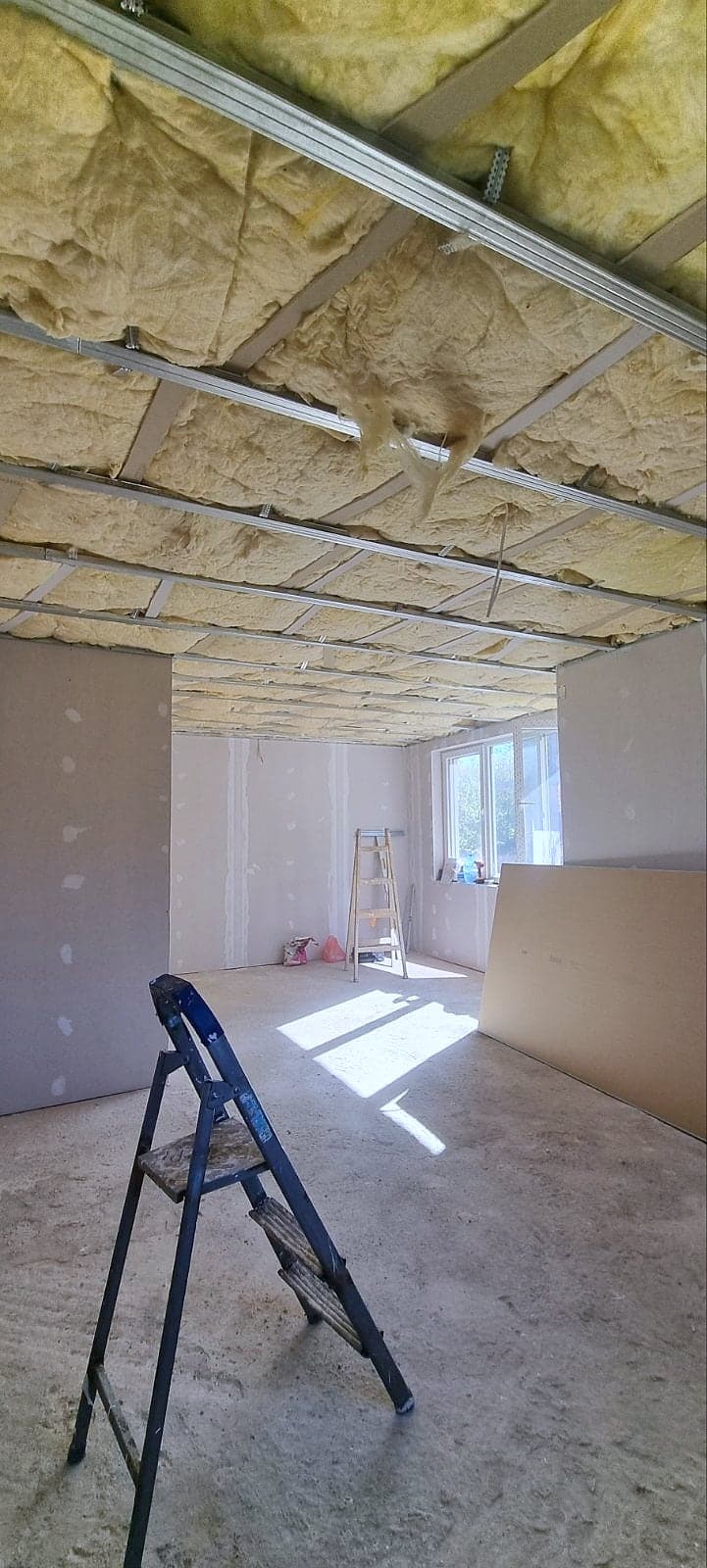 With mineral wool
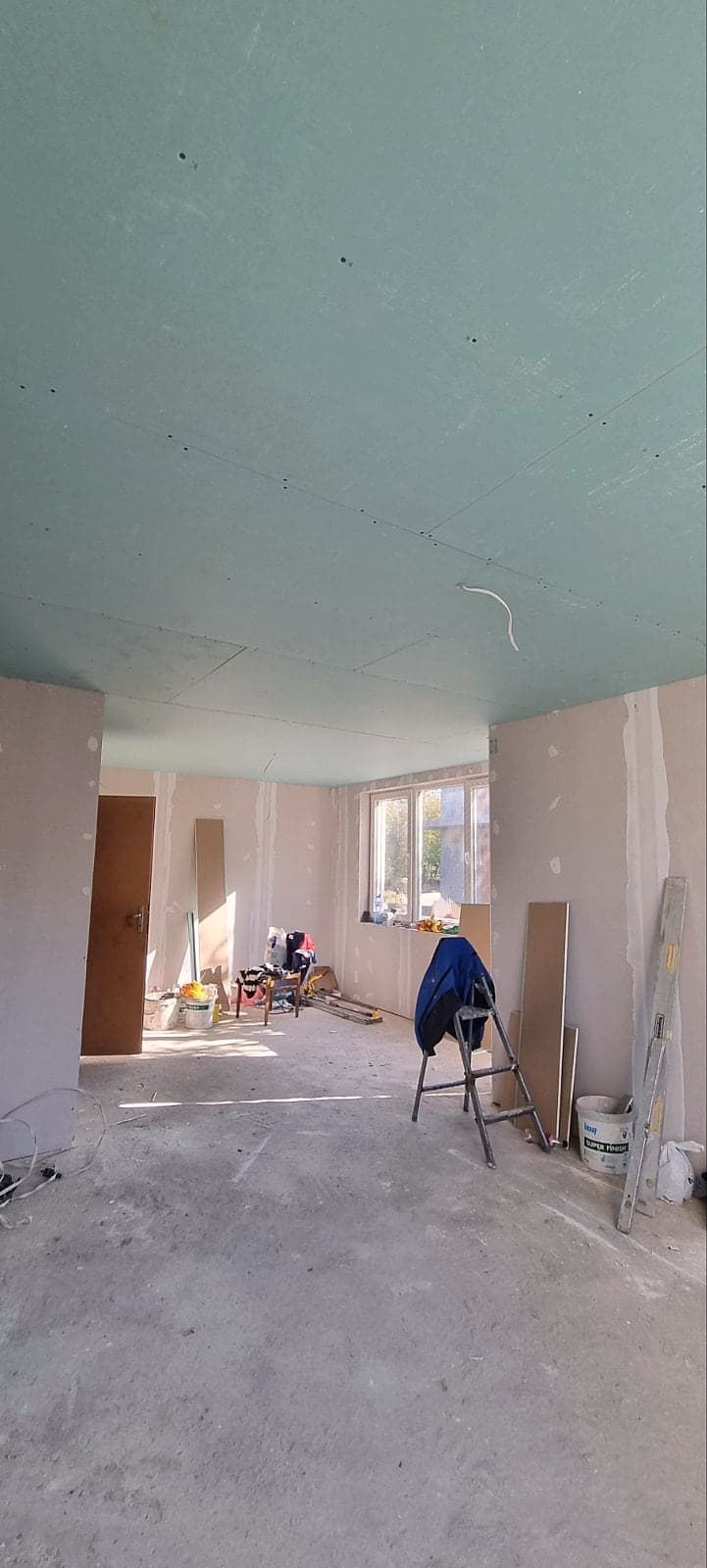 Closed up
Double frame
Here the profiles are in two layers – load-bearing profiles at the top and, below them, the profiles the boards are fixed to, running at right angles to the first. The frame is stronger and is chosen for larger rooms or when the ceiling has to carry more weight. In the price list it comes with mineral wool – €28.45 per m² for labour.
Two-level ceilings and perimeter bulkheads
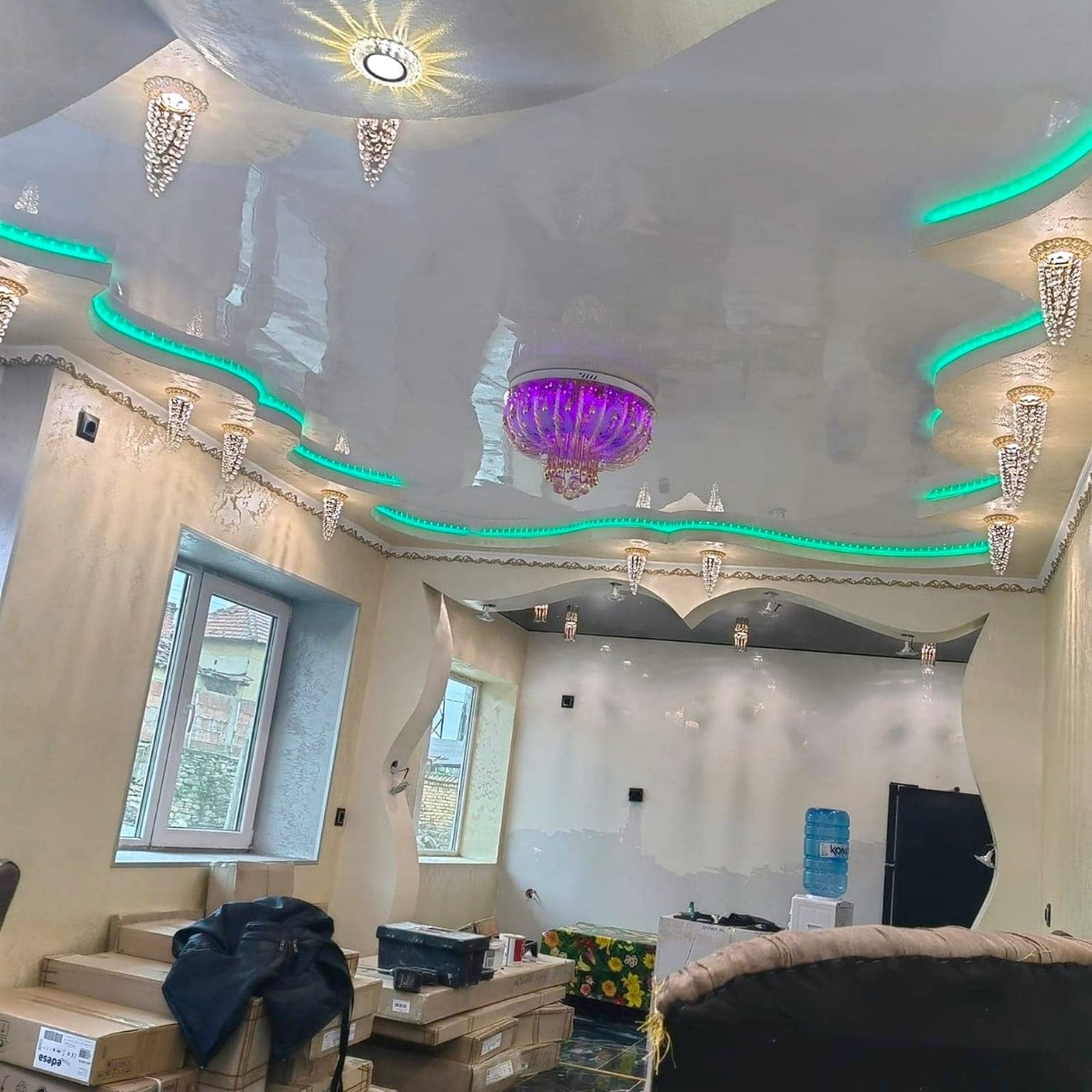
A two-level ceiling has a lower section over the table, over the sofa or along the walls. The LED strip is hidden in the step between the two levels. Labour is €37.58 per m² for the whole ceiling. This is how the living room with a suspended ceiling and LED lighting was done.
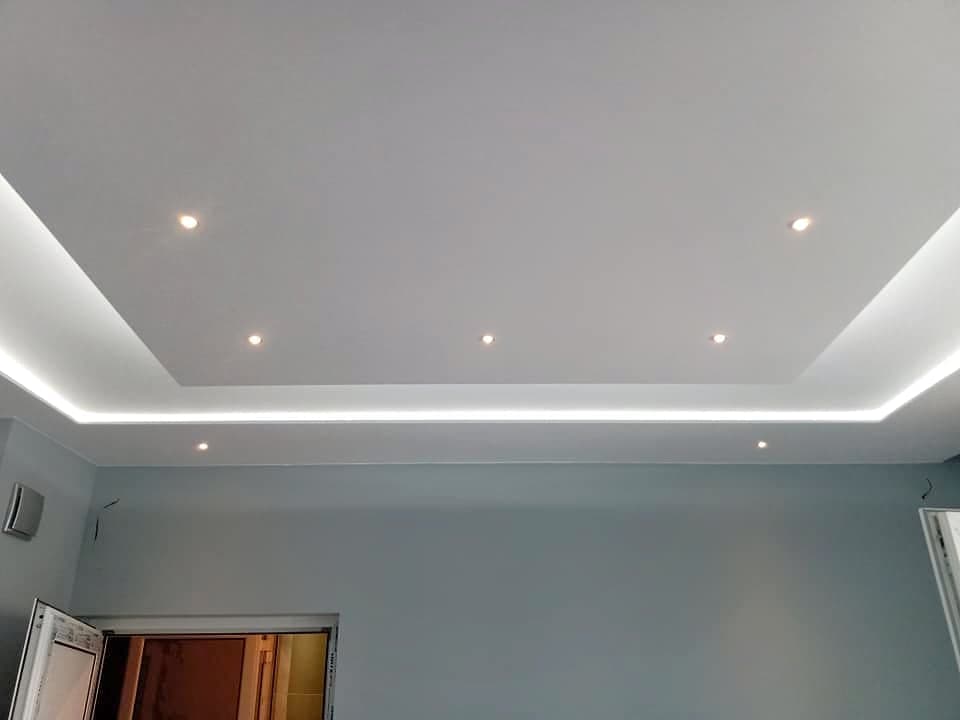
If you want concealed lighting without lowering the whole ceiling, the cheaper option is a plasterboard band along the walls only. It is priced per linear metre: €22.55 for a frame for concealed lighting or €30.68 for bulkheads with concealed lighting – both for labour. The centre of the ceiling stays at its original height, which is an advantage in a low room.
Shapes and curved forms
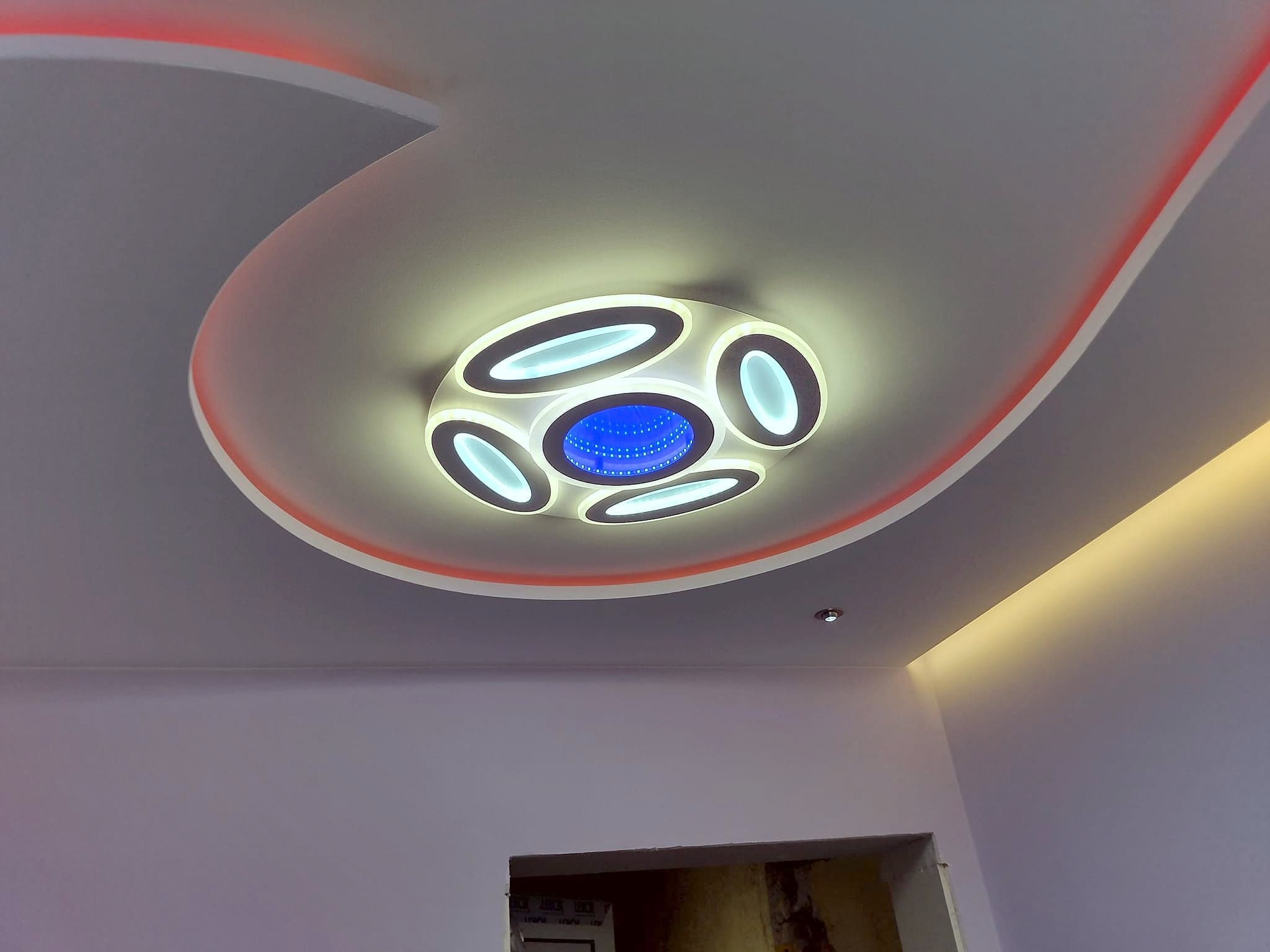
Curved edges, circles and illuminated geometric panels are built to a drawing. The price list has no unit price for them, because the labour depends entirely on the shape – the price is set in a quote after the site visit. We describe how curves are built in the article on curved plasterboard forms. An example from one of our projects is the attic room with a curved ceiling and LED lighting.
Stretch ceilings and grid ceilings
A stretch ceiling is a membrane held in profiles along the walls. It is installed without skim coating or paint, and the lighting is built in at the same time. The item ‘Installing a stretch ceiling + lighting’ is €69.79 per m²; exactly what it covers – the membrane, the profiles and the lighting – is set out in the quote. Light fittings are hard to add later, so their positions are decided in advance.
A grid ceiling is a metal grid with tiles that lift out, so everything above them stays accessible. It is common in offices, shops and basements, but in a home it looks utilitarian. Labour is €21.47 per m².
Lighting: LED strip, downlights and power supply
The lighting is planned together with the ceiling. The cables go in before the boards, and once the ceiling is closed up, any change means cutting it open and skim coating again.
The LED strip: soft, reflected light
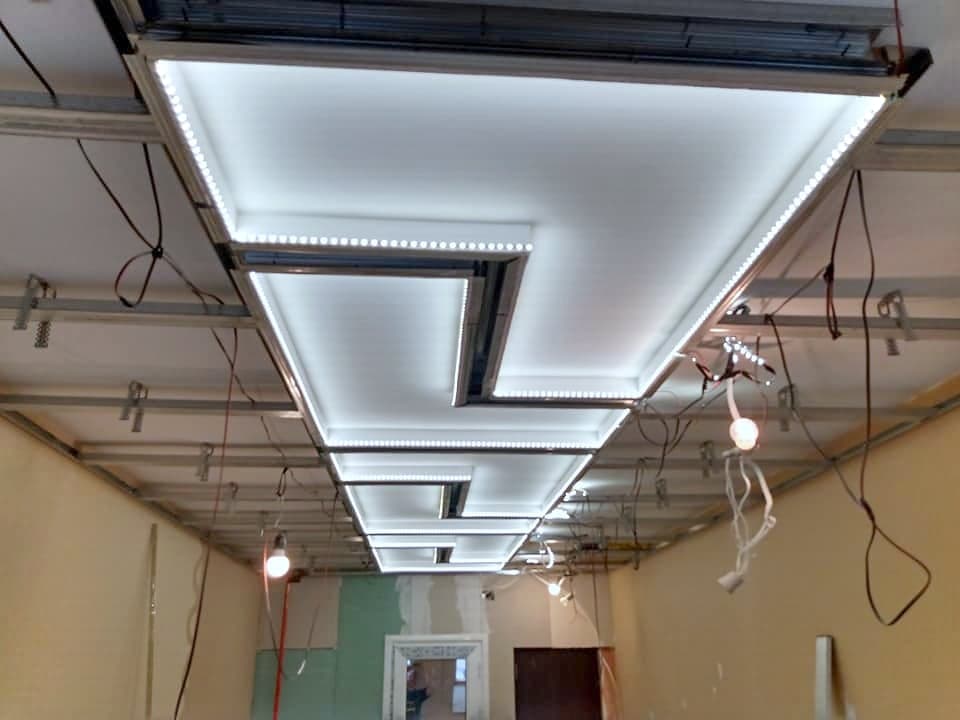
The strip is hidden in the step between the levels or in the band along the walls, and shines onto the ceiling or the wall. In the ceiling with geometric LED lighting, it is fitted along the edges of recessed panels. The light is reflected – soft and glare-free, good for the evening but not enough for working or reading.
Labour is €13.42 per linear metre for fitting and €8.05 for the wiring – €21.47 per metre in total. In an aluminium profile with a frosted cover, the strip stays cooler and the LEDs do not show as separate dots. On long runs, power is fed in at several points or a 24-volt strip is chosen; otherwise the light fades towards the end.
Downlights: light where you work
Recessed downlights shine downwards – over the worktop, the table, the desk or the wardrobe. They are positioned to suit the furniture, not just in an even grid. For each downlight, labour is €8.05 for the wiring and €10.74 for fitting – €18.79 each in total.
Power supply, switches and light colour
An LED strip usually runs on low voltage through a power supply (an LED driver). The power supply gets warm and may need replacing over the years, so it goes in an accessible place – in a cupboard, in the recess with the strip or behind an access panel – not sealed in for good above the plasterboard.
Also decide in advance how the lights will be switched on: with separate switches for the strip and the downlights, with a dimmer or with a remote control. Each new switch is a separate point – ‘Electrical wiring per point’ is €32.21 for labour. If you want to dim the lights, the power supply and the downlights have to support it.
Colour temperature is measured in kelvins: around 2,700–3,000 K is warm white light for a living room or bedroom, and around 4,000 K is neutral light for a kitchen, bathroom or work area. It is best for the strip and the downlights in one room to be the same colour, unless the difference is intentional. A colour-changing strip also needs a controller.
Example: a 16 m² room with a two-level ceiling
The example is for a 4 × 4 m room: a two-level ceiling with concealed lighting, 16 linear metres of LED strip and six downlights. The calculation follows the price list and covers labour only.
| Work | Quantity | Labour price |
|---|---|---|
| Installing a two-level suspended plasterboard ceiling with concealed lighting – €37.58 per m² | 16 m² | €601.28 |
| Fitting an LED strip – €13.42 per lin. m | 16 lin. m | €214.72 |
| Running the wiring for an LED strip – €8.05 per lin. m | 16 lin. m | €128.80 |
| Running the wiring for downlights – €8.05 each | 6 pcs | €48.30 |
| Fitting downlights – €10.74 each | 6 pcs | €64.44 |
| Total for the ceiling and lighting | €1,057.54 | |
| Jointing plasterboard + mesh – €5.37 per m² | 16 m² | €85.92 |
| Primer before skim coat, 2 coats of skim, sanding, dust removal, primer before paint, 2 coats of paint – €22.55 per m² | 16 m² | €360.80 |
| Total with jointing, skim coat and paint | €1,504.26 |
The skim coat is not a formality. Concealed light grazes across the ceiling and shows up every ripple and every badly sanded joint, so a ceiling with an LED strip needs more careful finishing than an ordinary one.
If you only need the concealed lighting, with no downlights in the middle, the frame along the walls works out cheaper: 16 linear metres × €22.55 = €360.80 for labour, instead of €601.28 for a two-level ceiling. The amount for your room depends on the shape, the number of downlights and the condition of the old ceiling – you will find it in the written quote after the site visit.
Before the ceiling is closed up
- Measure the height. Every level, downlight and layer of wool takes away centimetres, so in a low room a single-level ceiling or a band along the walls only is the better choice.
- Photograph the ceiling before it is closed up. The photo shows the profiles and the cables – you will need it when you drill for a chandelier or a curtain rail.
- Leave access. Wherever there are shut-off valves, junction boxes, a power supply or a ventilation duct above the ceiling, an access panel goes in – ‘Fitting an access panel’ is €42.95 for labour. Without one, the ceiling has to be cut open for every inspection.
- Under the roof – wool and a vapour barrier. On the room side, the wool is covered with vapour barrier film, which stops moisture from the room getting into it. If the roof leaks, repair the roof first: a suspended ceiling will hide the leak until a stain appears.
- Lighting – after the paint. The strip and the downlights are fitted once the skim coat and paint are done, so that they do not get covered in paint and dust.
Frequently asked questions
How much height does the room lose?
A ceiling fixed tight under the slab takes about 4–5 cm – the depth of the profiles and the board. With downlights, there has to be room for their housings, and the ceiling usually comes down by 8–10 cm; flat LED panels need less. With two levels, the lower section comes down further. The exact number of centimetres depends on the lighting and on what the ceiling is hiding.
How much does a suspended ceiling cost per m²?
Installing a plasterboard ceiling costs from €18.79 per m² for a simple ceiling to €37.58 for a two-level one – for labour. Jointing, skim coating and painting are charged separately, so a finished simple ceiling comes to €18.79 + €5.37 + €22.55 = €46.71 per m² for labour, excluding materials.
Can you have a suspended ceiling in a bathroom?
Yes, made of moisture-resistant plasterboard – ordinary plasterboard absorbs moisture from the steam and can sag over time. The bathroom needs an extractor fan, and the light fittings must be suitable for damp rooms, especially above the shower. For the ceiling of one bathroom or toilet, the price list has a per-item price: ‘Plasterboard suspended ceiling (bathroom/toilet)’ – €161.06 for labour.
How long does the ceiling in one room take?
A simple ceiling in a room of about 16 m² takes roughly a day or two to build, and a second level and lighting add another day or two. Jointing, skim coating and painting take several more days, because each coat has to dry. The exact schedule depends on the job and is set out in the quote.
Which is better – an LED strip or downlights?
They do not get in each other’s way – they complement each other: the strip gives soft background light, and the downlights give directed light for working. The most convenient option is to have both, on separate switches. Labour is €21.47 per linear metre of strip and €18.79 per downlight.
If you are considering a suspended ceiling, at the free site visit you will find out which type makes sense for your room and what it will cost. You will receive a written quote that lists the work and the price, and the warranty is also in writing: 24 months for the ceiling and 72 months for the electrical installation. You can read more about our work on the page about plasterboard in Sofia; when you are ready, send us a site visit request – we reply within 24 hours.
More articles
All articles Finishing work
11 min read
Plaster prices 2026 (labour): sand-finish, Venetian, travertine
Labour per m² for gypsum, lime-cement, sand-finish and Venetian plaster and silicone render, what the preparation adds and a worked example.
Read Finishing work
9 min read
How to avoid the most common mistakes when painting an apartment
At first glance, painting an apartment looks like an easy, manageable job, but in practice it often turns out to be a test full of pitfalls. Many owners decide to freshen up the walls and ceilings themselves, but seemingly minor oversights can lead to serious disappointment. The consequences can be patchy coverage, stains, peeling, cracking or even a colour that does not match the original idea.
Read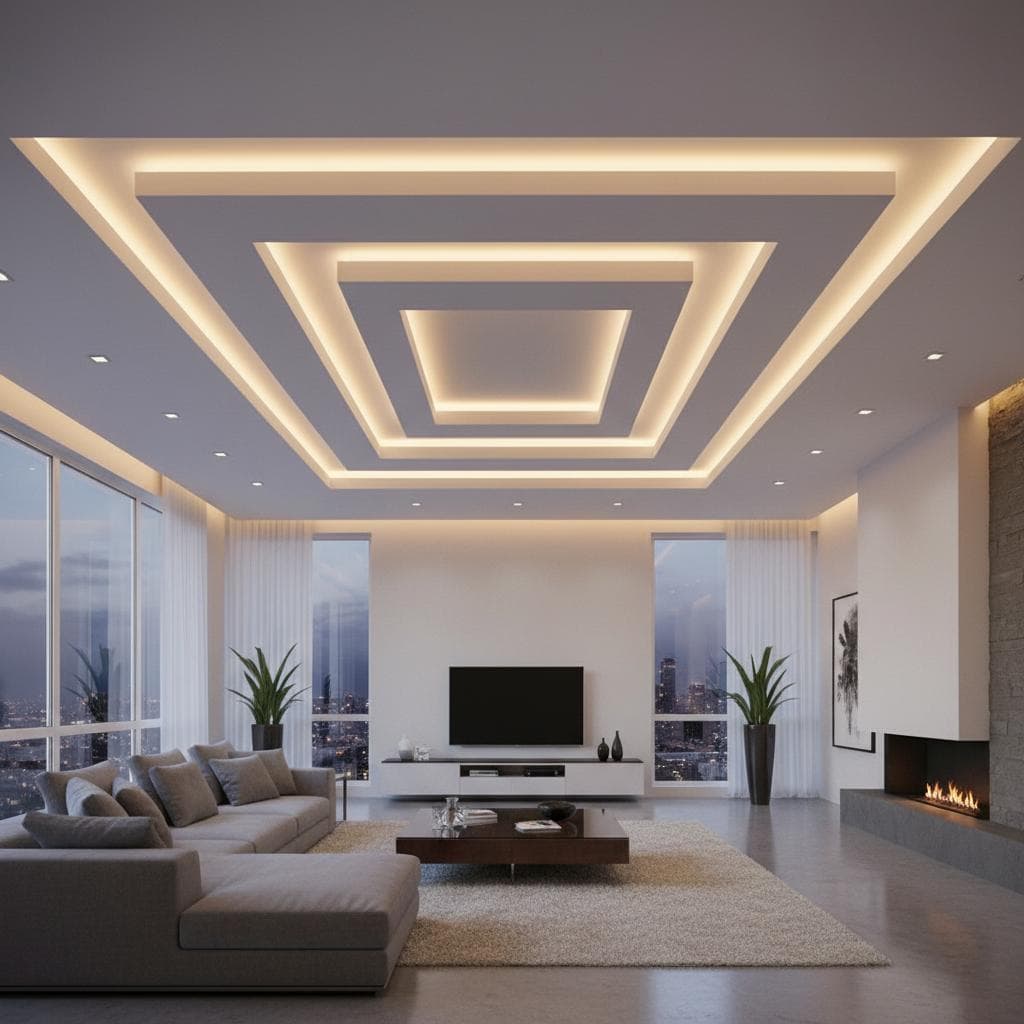 Finishing work
8 min read
Curved shapes in drywall: bold ideas for a striking ceiling
Have you ever thought about how a ceiling can transform the whole feel of your home? With a drywall ceiling you can go far beyond straight lines and achieve movement, flow and a unique character. While classic flat surfaces create a sense of completeness, curved and three-dimensional structures add an element of surprise, style and individuality that instantly catches the eye.
Read