Plaster prices 2026 (labour): sand-finish, Venetian, travertine
Labour per m² for gypsum, lime-cement, sand-finish and Venetian plaster and silicone render, what the preparation adds and a worked example.
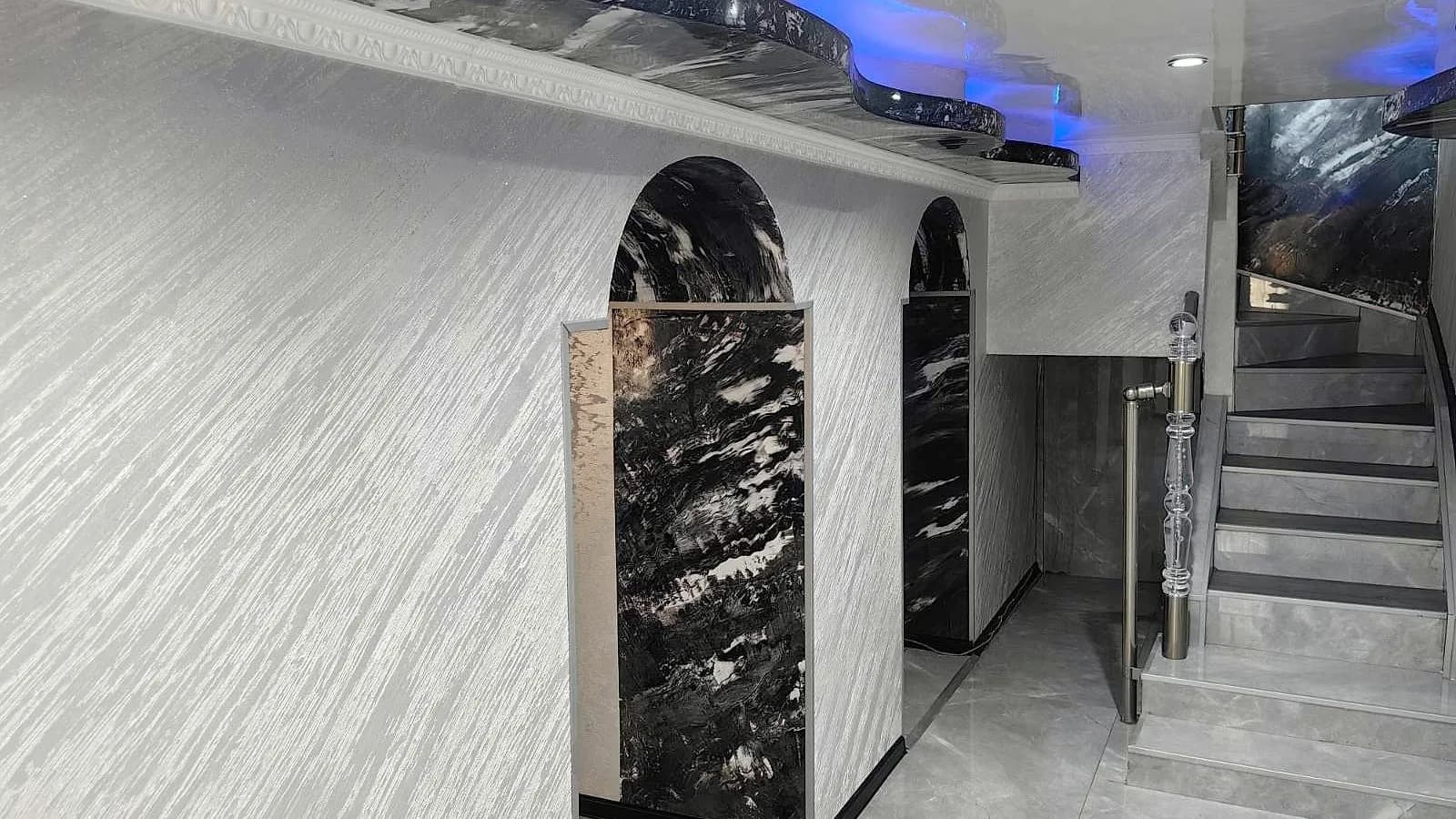
Labour for the plaster itself costs from €9.66 per m² (gypsum plaster) to €40.00 per m² (travertine-effect plaster). Sand-finish plaster is €10.74, silicone render €11.81 and Venetian plaster €34.90 per m² for labour.
Materials are not included – except in three items, which are grouped in a separate table. Preparing the wall (removing the old plaster, primer, skim coat, mesh) is also charged separately. With sand-finish plaster, for example, the preparation costs more than the plaster itself.
Below are the prices from our price list for the plasters and the preparation, a short description of each type and a worked example for one wall with three different plasters. Prices are as of October 2026 and may change.
Labour prices by type of plaster
The items are named as in our price list and ordered by price.
| Plaster (price-list item) | Price for labour |
|---|---|
| Gypsum plaster, up to 2 cm | €9.66 per m² |
| Sand-finish plaster | €10.74 per m² |
| Applying silicone render | €11.81 per m² |
| Plastering with lime-cement plaster | €13.42 per m² |
| Applying façade render | €16.11 per m² |
| Removing plaster + applying silicone/scratch-finish render | €18.79 per m² |
| Applying white plaster + primer | €19.86 per m² |
| Mineral render | €20.00 per m² |
| Lime-cement plaster | €21.47 per m² |
| Applying coloured lime-cement plaster – green; NCS S 3010-G50Y | €24.16 per m² |
| Applying coloured lime-cement plaster – white; RAL: 9010 | €29.53 per m² |
| Applying Venetian plaster | €34.90 per m² |
| Applying travertine-effect plaster | €40.00 per m² |
| External insulation + skim coat with mesh and render | €64.42 per m² |
Lime-cement plaster appears as two items – at €13.42 and at €21.47 per m² for labour; we state which one applies to your walls in the quote after the site visit. The RAL and NCS references in the names are catalogue colour codes. ‘External insulation + skim coat with mesh and render’ is the complete thermal insulation of the façade, not just the render.
Plastering often also involves preparing the wall or removing the old plaster:
| Preparation and repairs (price-list item) | Price for labour |
|---|---|
| Primer before plastering | €1.34 per m² |
| Concrete bonding primer | €3.00 per m² |
| Removing plaster | €5.37 per m² |
| Hacking off wall plaster | €10.00 per m² |
| Preparing walls for tiling – plasterboard/plaster | €16.11 per m² |
| Preparation for tiling – plaster | €18.79 per m² |
| Preparing walls for tiling – plaster + mesh | €21.47 per m² |
| Primer before skim coating, 2 skim coats, primer before plastering, applying plaster | €25.77 per m² |
| Straightening walls – plaster + mesh | €26.59 per m² |
| Wall plaster repair | €26.84 each |
Three items also include the materials. The first is machine-applied plaster (known colloquially in Bulgaria as ‘turbozolna’).
| Item including materials | Price for labour and materials |
|---|---|
| Machine-applied plaster (labour + materials) | €22.55 per m² |
| Applying white plaster; RAL: 9010 (labour and materials) | €24.16 per m² |
| Applying façade render (labour and materials) | €32.21 per m² |
Base plaster: gypsum and lime-cement
Base plaster straightens the wall and prepares it for skim coating, paint or tiles. The type is chosen to suit the room. How we apply it – by machine or by hand, checking the walls with a laser and a straightedge – is described on the plastering page.
Gypsum plaster – €9.66 per m² for labour
Gypsum plaster is for dry rooms – bedrooms, living rooms and hallways. Its surface is smoothed, and after that a thin skim coat is usually enough before painting. We usually do not use it in bathrooms and toilets – there we prefer lime-cement plaster, which copes better with moisture. The price-list rate is for a coat up to 2 cm thick; on a more uneven wall, the coat is thicker and the labour cost goes up.
Lime-cement plaster – €13.42 or €21.47 per m² for labour
Lime-cement plaster copes better with moisture: it is used in bathrooms, toilets and other damp rooms, as well as on external walls. Its surface is rougher – it is skim coated under paint, but this is not needed under tiles. Pure lime plaster has no separate item in the price list – it is priced in the quote after the site visit.
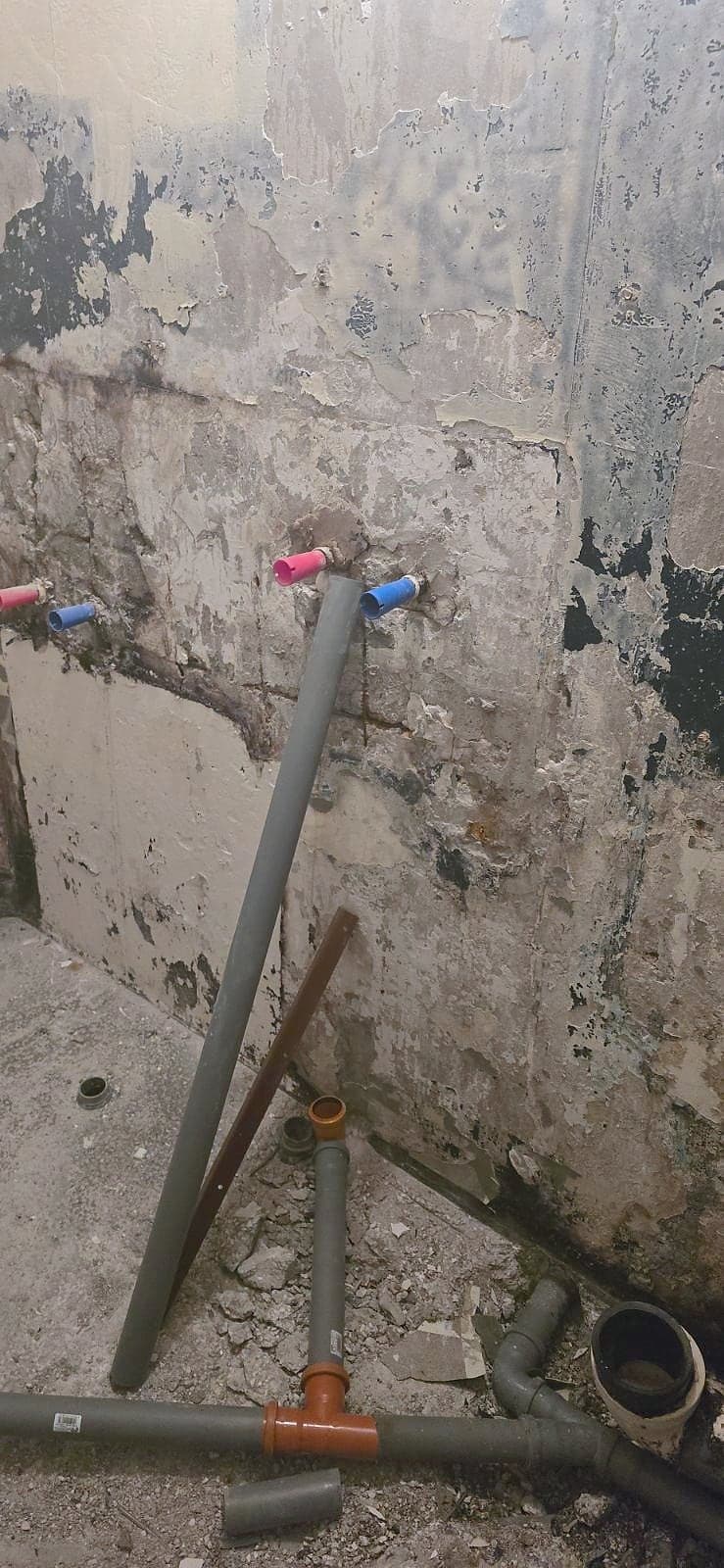
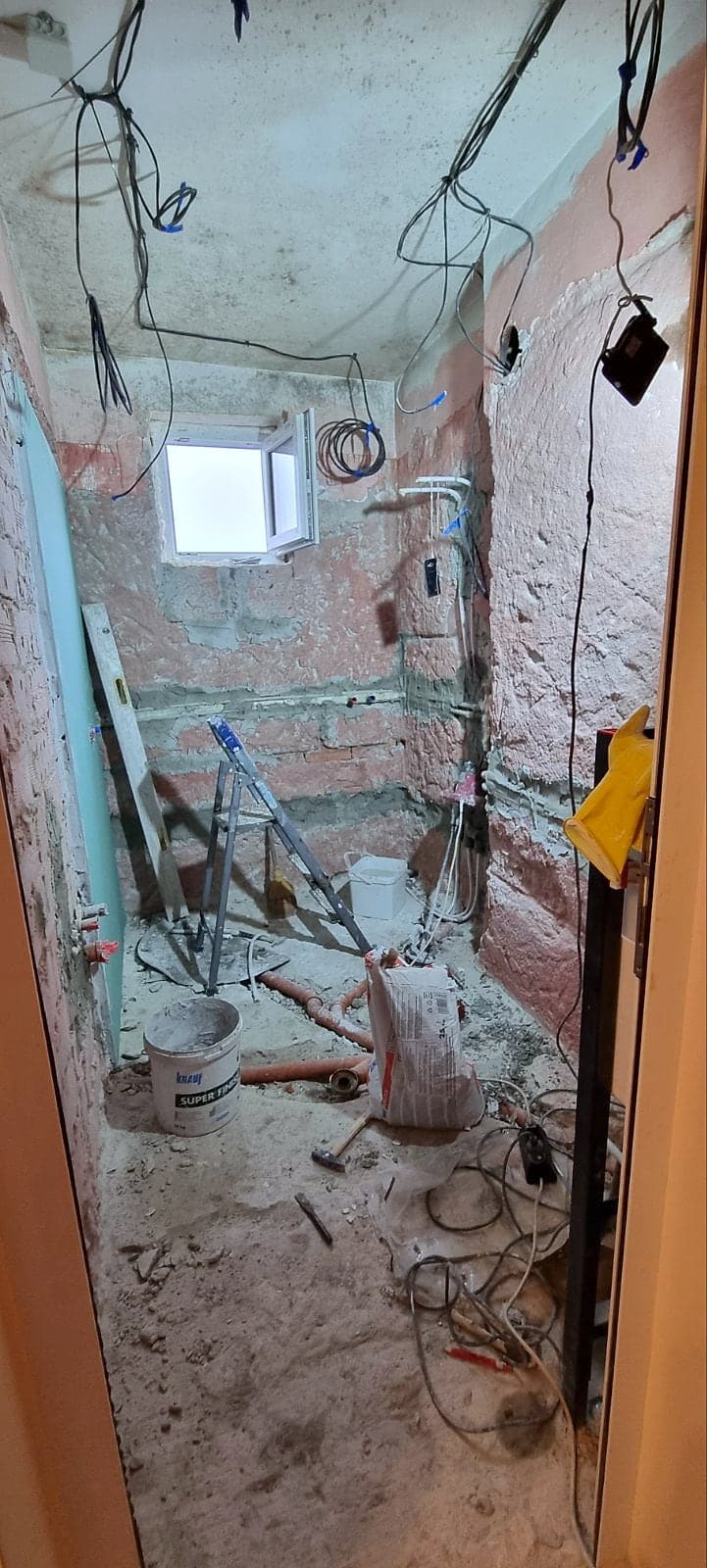
In a bathroom, the walls are often uneven after the strip-out, as in the photos below. Before tiling, they are straightened with plaster and mesh or lined with moisture-resistant plasterboard. ‘Preparing walls for tiling – plaster + mesh’ is €21.47 per m² for labour. In the sample budget for a 4 m² bathroom in the article on the labour cost of a bathroom renovation, this comes to 22 m² × €21.47 = €472.34 for labour.
Decorative plasters for interior walls: sand-finish, Venetian, travertine
Decorative plaster is the final, visible layer. It is applied thinly over a flat, sound and primed wall – usually a skim-coated one – so the preparation is added to its price. There is more detail on the composition and properties of each type in the article on types of plaster and their uses, and a comparison with painting in the article plaster or paint.
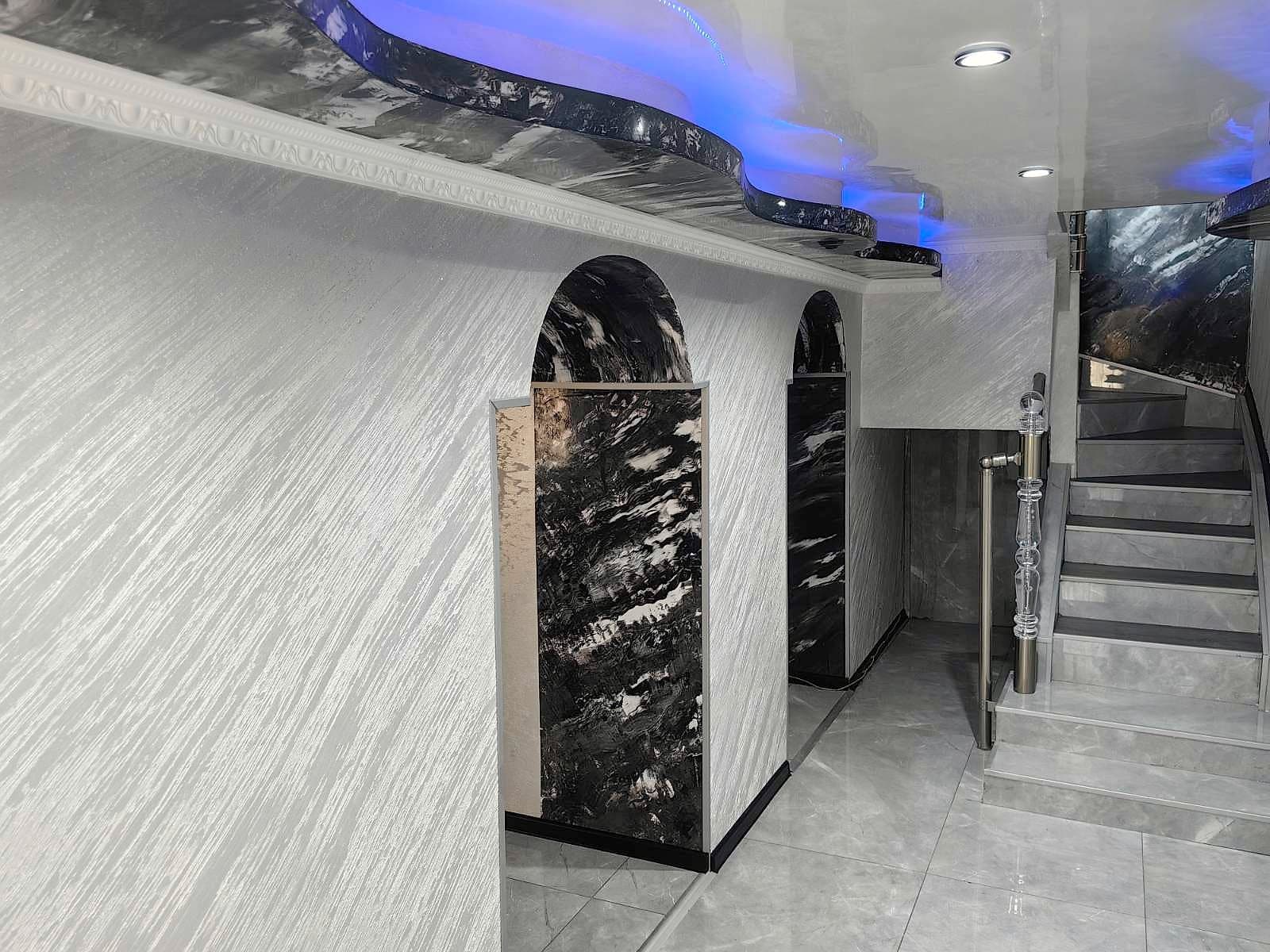
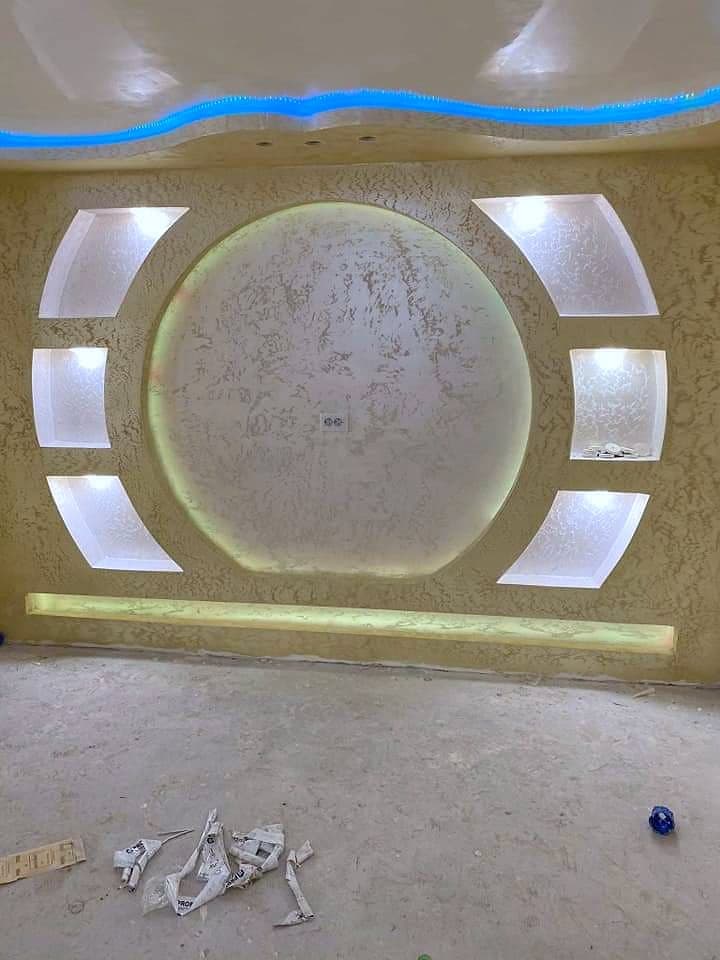
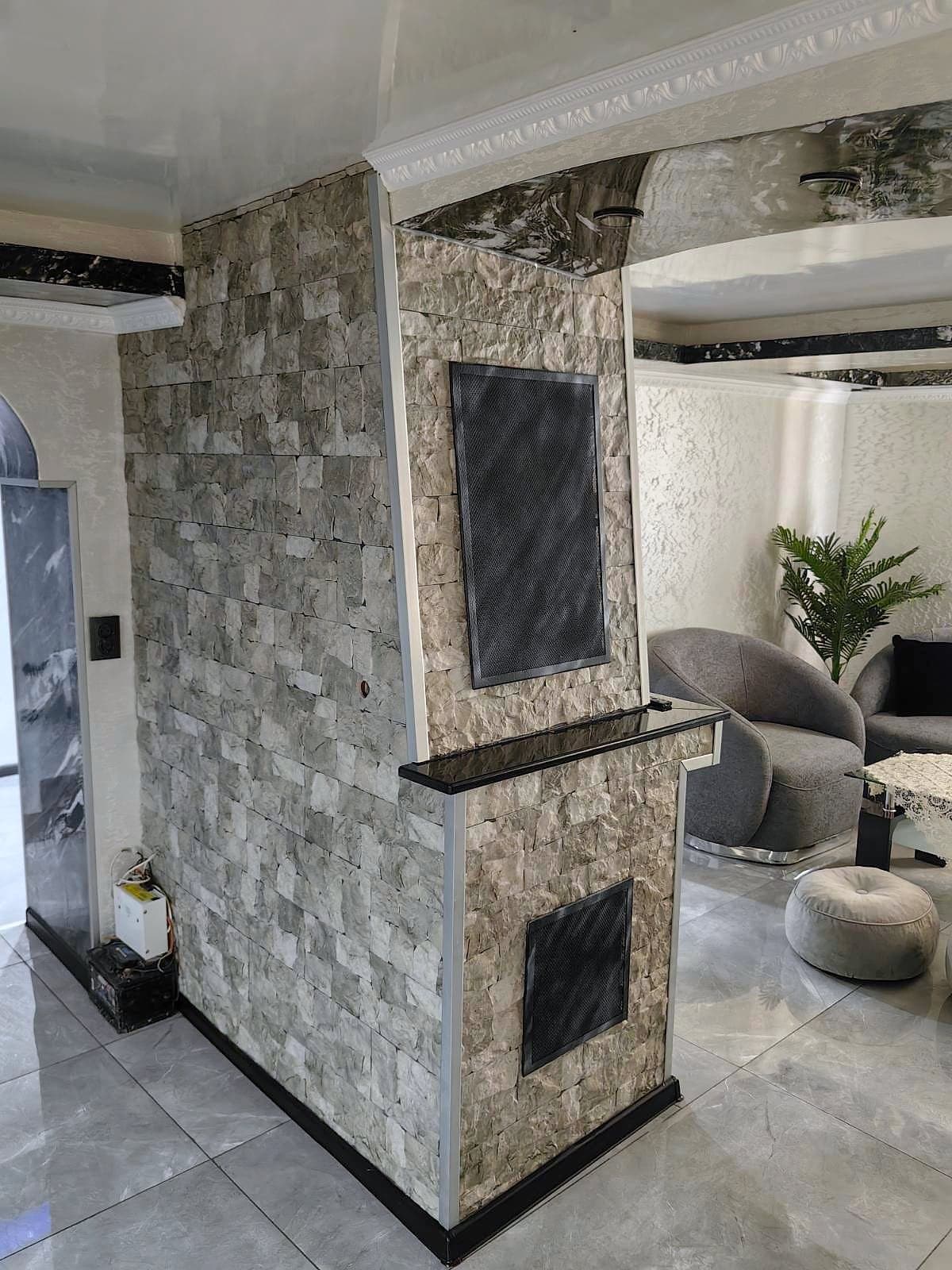
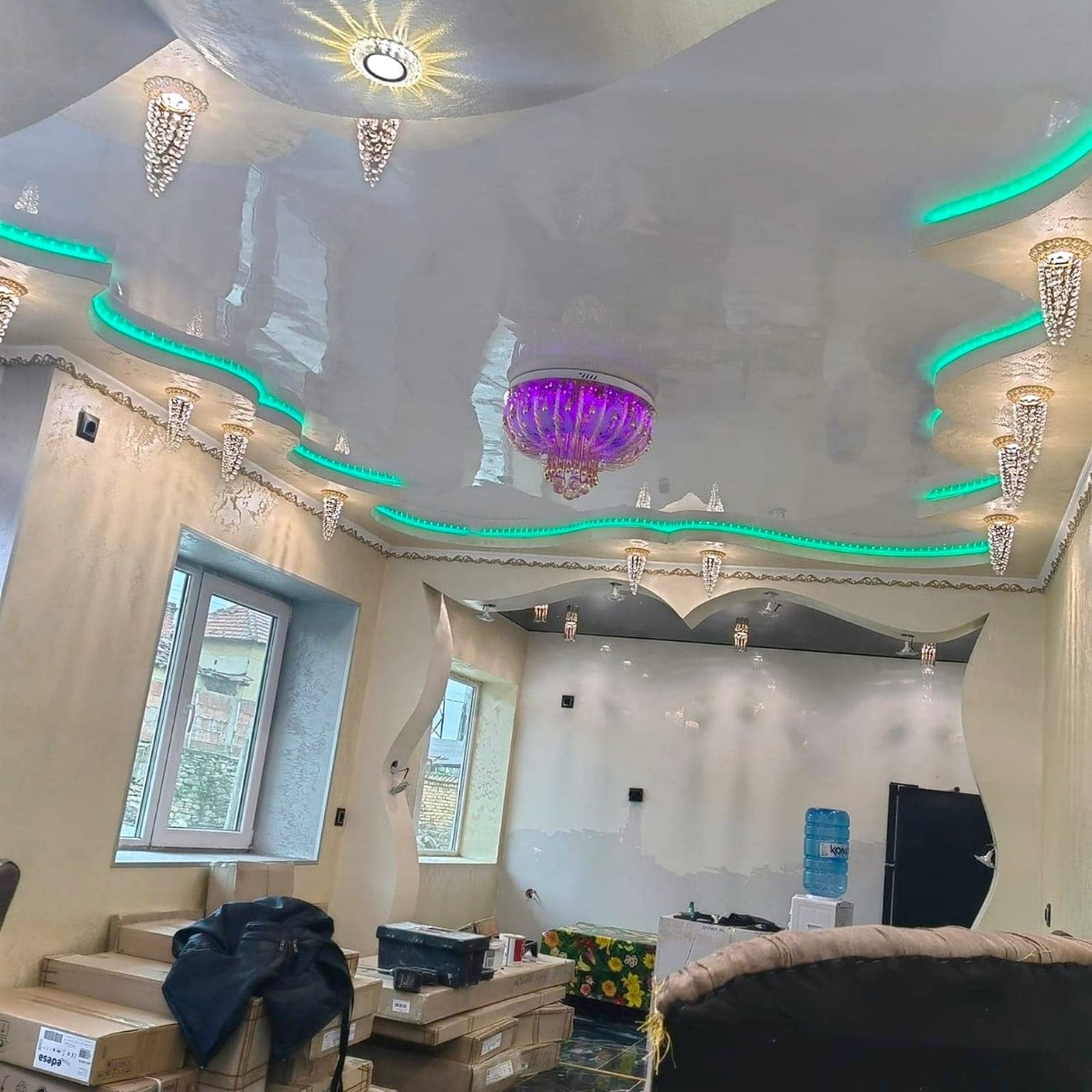
The photos in this section are from the house with decorative ceilings, walls and arches, where the decorative plaster is on the walls of the hallway, the living room and the other rooms.
Sand-finish plaster – €10.74 per m² for labour
Sand-finish plaster gives a fine, evenly grained surface that resembles sand. The coat is thin: it hides small scratches and imperfections better than paint, but it will not straighten an uneven wall. Its labour cost is the lowest of the decorative plasters.
Venetian plaster – €34.90 per m² for labour
Venetian plaster is smooth, with a soft sheen and a depth reminiscent of polished marble. It is applied by hand with a steel trowel in several thin coats, and the last coat is polished to a sheen. The thin coats hide nothing and every imperfection underneath shows, so the base has to be perfectly smooth. The work is slow – the labour costs more than three times as much as for sand-finish plaster.
Travertine-effect plaster – €40.00 per m² for labour
Travertine-effect plaster imitates the stone it is named after – with pores, veins and a slightly uneven, layered surface. It is applied in several coats and the pattern is shaped by hand, which is why its labour cost is the highest of the decorative plasters. It suits feature walls, columns and niches.
Façade and textured renders: silicone, scratch-finish, mineral
Façade render – €16.11 per m² for labour
‘Façade render’ is the usual name for the finishing coat on external walls. It can be silicone, silicate, acrylic or mineral. It is applied over a mesh-reinforced skim coat or over sound old plaster, in dry weather and at the temperature the manufacturer requires – which is why façade work is planned between spring and autumn.
The item including materials is €32.21 per m² for labour and materials. When the façade is insulated, the render is the last layer of the system, and the whole job – insulation, mesh-reinforced skim coat and render – is a single item: €64.42 per m² for labour. Scaffolding is separate: putting it up and taking it down costs €18.00 per m² for labour. There is more about work on external walls on the façades and common areas page.
Silicone and scratch-finish render – from €11.81 per m² for labour
Silicone render is supplied as a ready-to-use paste, tinted to the chosen colour, and is not painted afterwards. It repels water but lets water vapour through, so it is used mainly on façades, including as the final coat over thermal insulation.
‘Scratch-finish’ is not a separate material but a texture – an even, grainy surface. Silicone, mineral or acrylic render can all have this texture; with a ‘dragged’ texture, by contrast, the grains leave grooves. In the price list, scratch-finish render shares an item with removing the old plaster: €18.79 per m² for labour.
Mineral render – €20.00 per m² for labour
Mineral render is based on lime, cement or both, and usually comes as a dry mix that is mixed with water on site. It lets water vapour through and is used both on façades and indoors, with a scratch-finish or dragged texture.
Example: one wall with three decorative plasters
Take a wall measuring 4 × 2.5 m, i.e. 10 m², that is already plastered, sound and free of major unevenness. The preparation is the same for all three plasters: primer before skim coating (€1.34) + 2 skim coats (€10.74) + primer before plastering (€1.34) = €13.42 per m² for labour.
| Plaster | Preparation, labour per m² | Plaster, labour per m² | Total for 10 m², labour |
|---|---|---|---|
| Sand-finish | €13.42 | €10.74 | €241.60 |
| Venetian | €13.42 | €34.90 | €483.20 |
| Travertine-effect | €13.42 | €40.00 | €534.20 |
For the same wall, travertine-effect plaster comes to €534.20 and sand-finish plaster to €241.60: a difference of €292.60 for labour. If the wall is more uneven, the preparation costs more – with 3 skim coats (€15.03 instead of €10.74) it becomes €1.34 + €15.03 + €1.34 = €17.71 per m² for labour. And if the old plaster is hollow, removing it and replastering are added to the bill.
How the area is measured and what drives up the labour cost
Plastering is priced per square metre of wall or ceiling: the length times the height, as in the example above. We specify how windows, doors and the reveals around them are counted in the quote after the site visit, when we measure the areas room by room.
For the same area, the labour cost depends on:
- The old plaster. Hollow and crumbling areas are removed down to a sound base instead of being plastered over: €5.37 (‘Removing plaster’) or €10.00 per m² (‘Hacking off wall plaster’) for labour – which item applies becomes clear at the site visit.
- Uneven walls. A larger deviation needs a thicker coat, and that shows in the price: ‘MP 75 skim coat’ (a machine-applied gypsum mix) is €10.74, while ‘MP 75 skim coat over 2 cm’ is €13.42 per m² for labour. Straightening with plaster and mesh is €26.59 per m² for labour, and for a very uneven wall, lining it with plasterboard is sometimes the more sensible option – we will tell you at the site visit.
- The substrate. On smooth concrete, a bonding primer is applied first – ‘Concrete bonding primer’ is €3.00 per m² for labour.
- Corners, reveals, arches and niches. The edges are formed with beads and finished by hand, so a wall with many openings and angles takes more labour than a plain wall of the same area.
- Height. High walls – in stairwells and on façades – are plastered from scaffolding, which is a separate item.
- Small repairs. An isolated patch is priced per item, not per square metre: ‘Wall plaster repair’ is €26.84 per item for labour.
Frequently asked questions
What is the difference between plaster and skim coat?
Base plaster straightens the wall, and its coat is about a centimetre thick or more, depending on how uneven the wall is. A skim coat is a thin layer of a few millimetres that smooths the surface for painting – 2 skim coats are €10.74 per m² for labour. The order is plaster, skim coat, paint; decorative plaster is a thin final finish that replaces the paint. There is more about skim coating on the skim coating in Sofia page.
Are materials included in the price?
No. The prices are for labour only; materials are calculated separately and shown on a separate line in the quote. The exceptions are the three items including materials: machine-applied plaster (€22.55), white plaster RAL 9010 (€24.16) and façade render including materials (€32.21) – these prices are per m², for labour and materials.
Which plaster is suitable for a bathroom?
Lime-cement plaster: it copes with moisture better than gypsum plaster. In a bathroom, waterproofing also goes under the tiles: across the whole floor and on the walls in the shower area. Decorative plaster in a bathroom is only possible if the product is designed for damp rooms – this is stated in the manufacturer’s instructions.
How long does plaster take to dry?
It depends on the type and thickness of the coat, the temperature and the ventilation – the manufacturer of the mix gives a guideline. A skim coat, paint or a decorative layer is applied only once the base plaster has dried completely; otherwise the moisture stays trapped underneath. With decorative plasters, there is also a wait between the individual coats, as set out in the product instructions.
Can you plaster over old paint?
It depends on the paint. Sound, well-bonded paint is cleaned, glossy paint is sanded back to matt, then the surface is primed and the plaster applied. Flaking paint is removed, and oil-based paint usually is too (‘Removing oil-based paint’ – €91.27 per item for labour). We check which of these applies to you at the site visit.
The exact price for your walls is set after a site visit: we measure the areas and the deviations, and in the written quote we describe the type of plaster, the preparation and the price for labour. The site visit is free, and the renovation comes with a 24-month written warranty. Book a site visit – we reply to enquiries within 24 hours.
More articles
All articles Finishing work
9 min read
How to avoid the most common mistakes when painting an apartment
At first glance, painting an apartment looks like an easy, manageable job, but in practice it often turns out to be a test full of pitfalls. Many owners decide to freshen up the walls and ceilings themselves, but seemingly minor oversights can lead to serious disappointment. The consequences can be patchy coverage, stains, peeling, cracking or even a colour that does not match the original idea.
Read Finishing work
8 min read
Curved shapes in drywall: bold ideas for a striking ceiling
Have you ever thought about how a ceiling can transform the whole feel of your home? With a drywall ceiling you can go far beyond straight lines and achieve movement, flow and a unique character. While classic flat surfaces create a sense of completeness, curved and three-dimensional structures add an element of surprise, style and individuality that instantly catches the eye.
Read Finishing work
8 min read
Plaster vs paint – which is the better choice for your interior?
When it is time for an interior renovation, one of the most common questions homeowners ask is: should I go for paint or decorative plaster? Both have their own advantages, look and price points, which makes each suitable in different situations. The choice is not just about aesthetics – it has a direct effect on the atmosphere, the durability and even the budget of the renovation.
Read