Wallpaper hanging: cost per m² and how to prepare the wall
Hanging wallpaper costs €11.00 per m² for labour, stripping it €4.60. What the preparation adds, which wallpaper suits which room and how many rolls.
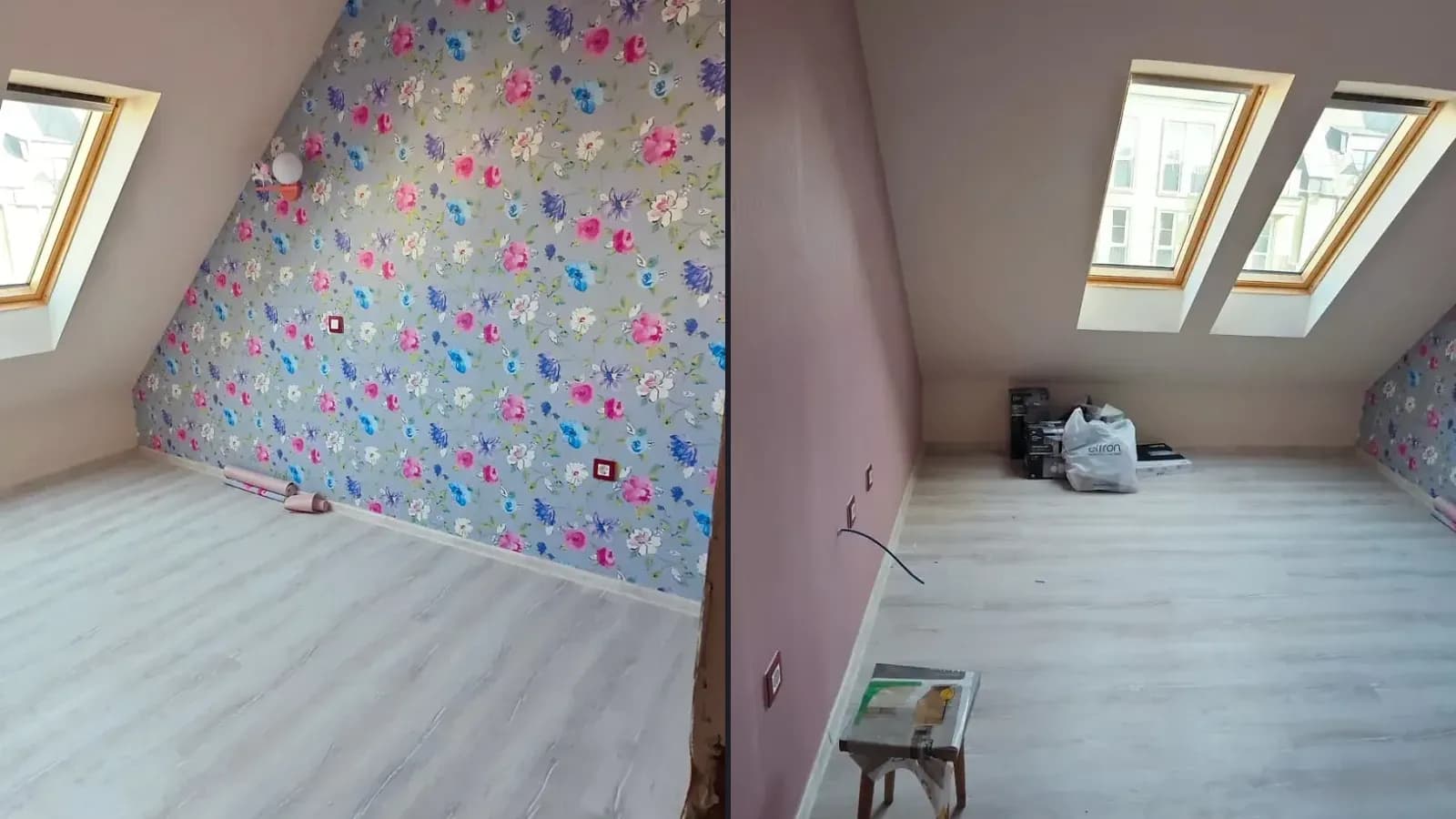
Hanging wallpaper costs €11.00 per m² for labour, according to our price list as of October 2026. Stripping old wallpaper is €4.60 per m², and applying liquid wallpaper €10.00 per m² – also for labour only. The wallpaper, adhesive and primer are priced separately.
For a 3.5 × 2.6 m wall that is smooth and sound, labour comes to €112.29 – priming and hanging. If the same wall first has to be skim coated, the labour total rises to €236.87: the preparation works out more expensive than the hanging itself.
That is why most of this article is about the wall beneath the wallpaper. Then come the types of wallpaper, how to work out the number of rolls and the alternatives – liquid wallpaper and paint.
Labour prices: wallpaper and wall preparation
| Task | Labour price |
|---|---|
| Hanging wallpaper | €11.00 per m² |
| Applying liquid wallpaper | €10.00 per m² |
| Stripping wallpaper | €4.60 per m² |
| Priming before painting (and before wallpapering) | €1.34 per m² |
| Primer, 1 skim coat, sanding, dust removal and primer | €10.20 per m² |
| Primer, 2 skim coats, sanding, dust removal and primer | €15.03 per m² |
In the price list, preparation comes in packages: primer, one or two skim coats, sanding, dust removal and a final coat of primer on top – which also serves as the primer before hanging. If the wall is smooth and sound, primer alone is enough: €1.34 per m² for labour.
Example: what one wall costs
Take a wall 3.5 m wide and 2.6 m high, with no windows or doors: 3.5 × 2.6 = 9.1 m². Here is the labour in two cases – when the wall is ready for wallpaper and when it first needs skim coating.
| Task and calculation | Labour: smooth wall | Labour: wall with skim coating |
|---|---|---|
| Priming: 9.1 m² × €1.34 | €12.19 | – |
| Primer, 2 skim coats, sanding, dust removal and primer: 9.1 m² × €15.03 | – | €136.77 |
| Hanging wallpaper: 9.1 m² × €11.00 | €100.10 | €100.10 |
| Total | €112.29 | €236.87 |
If there is old wallpaper on the wall, add the cost of stripping it too: 9.1 m² × €4.60 = €41.86 for labour. Once it has been stripped, the wall often needs skim coating – in that case, the total labour is €236.87 + €41.86 = €278.73.
If there are only a few defects (scratches, nail holes), a single skim coat is sometimes enough – the package with primer, sanding and primer on top comes to 9.1 m² × €10.20 = €92.82 for labour, instead of €136.77 for two coats. How many coats and how many square metres are needed is established at the site visit and set out in the written quote.
Why preparation determines the result
Most wallpapers are thin and mirror the wall beneath them. Every nail hole, blob of skim coat or grain of sand shows through, especially on smooth, plain or glossy wallpapers and when the light comes from the side. Thick and textured wallpapers hide more, but they will not fix an uneven or crumbling wall either.
Before hanging, the wall must be:
- sound – the paint and plaster are not crumbling or flaking;
- dry – any new plaster or skim coat has dried in line with the manufacturer’s instructions;
- clean – free of dust, grease marks and old adhesive residue;
- smooth – holes and cracks have been filled, and any unevenness skim coated and sanded;
- primed – so that it absorbs evenly and does not soak up the adhesive; on plasterboard, the primer also protects the paper facing when the wallpaper is stripped years later.
If there is mould on the wall, look for the cause first – a leak, condensation or poor ventilation. Wallpaper over mould only hides it for a while.
The photos of the garage in Mladost show how much work can lie beneath the finish: the old, stained walls were skim coated first and only then painted. Under wallpaper, the steps are the same – cleaning, filling, skim coating, sanding and priming.
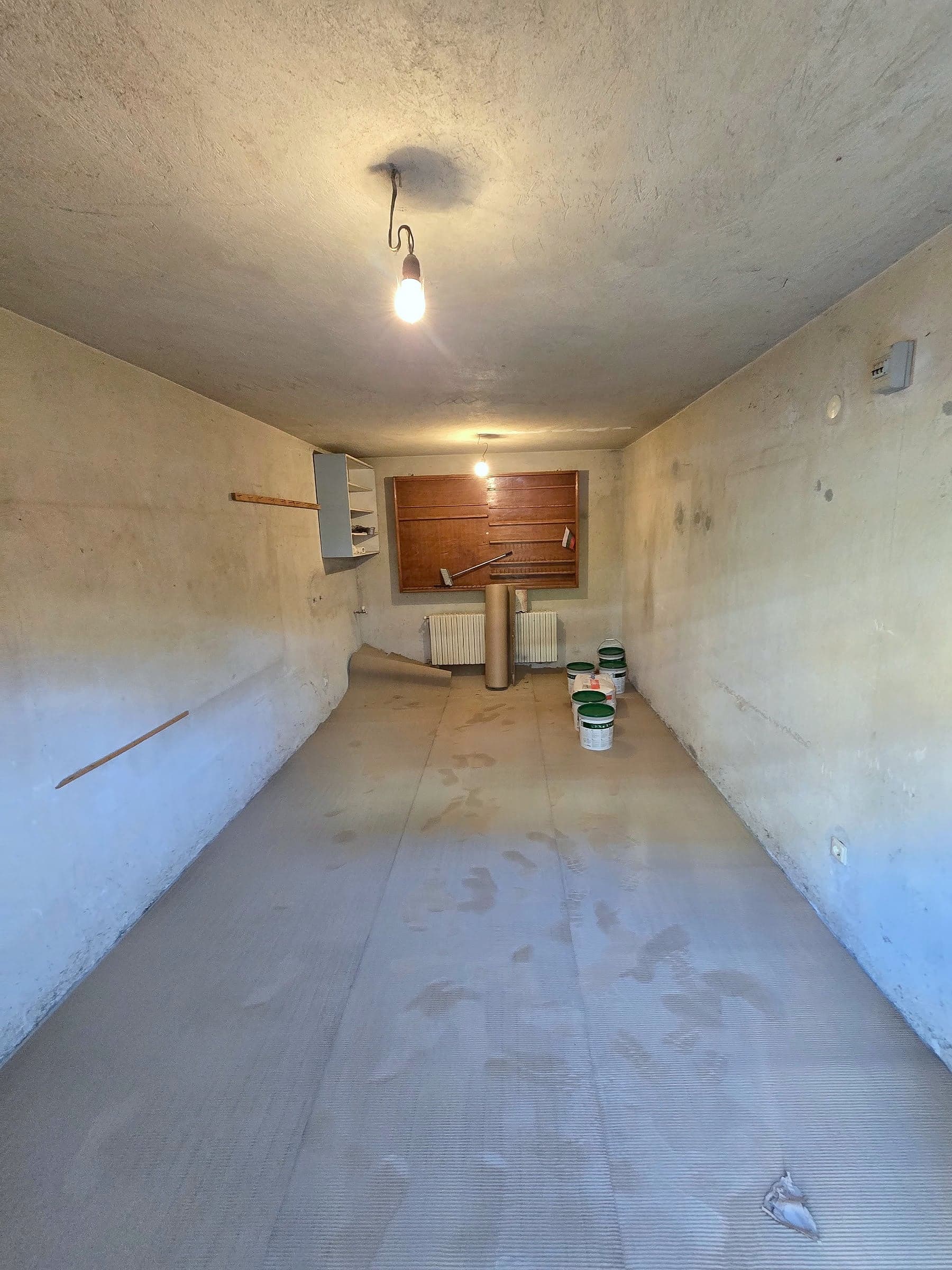 Before
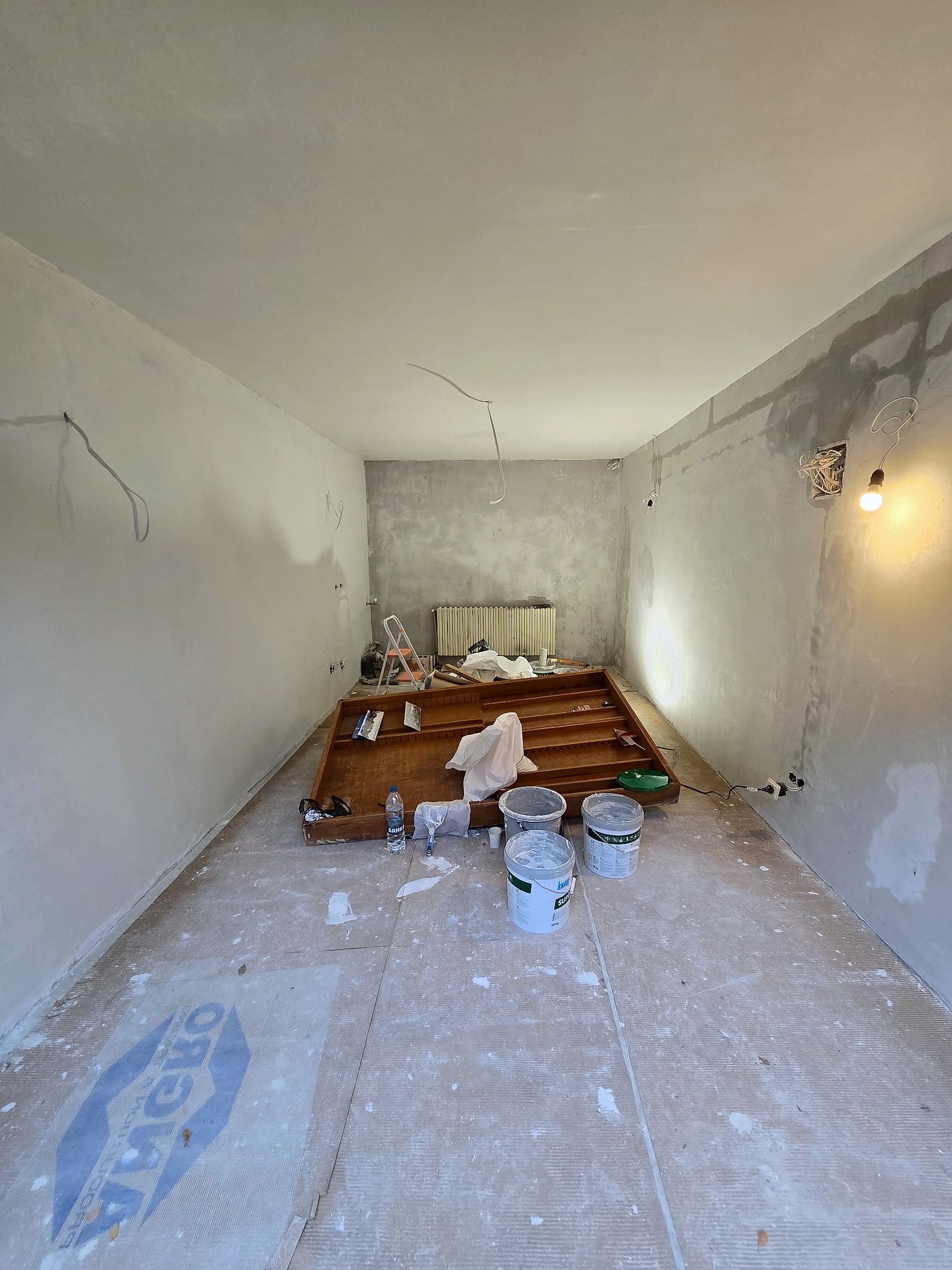 During
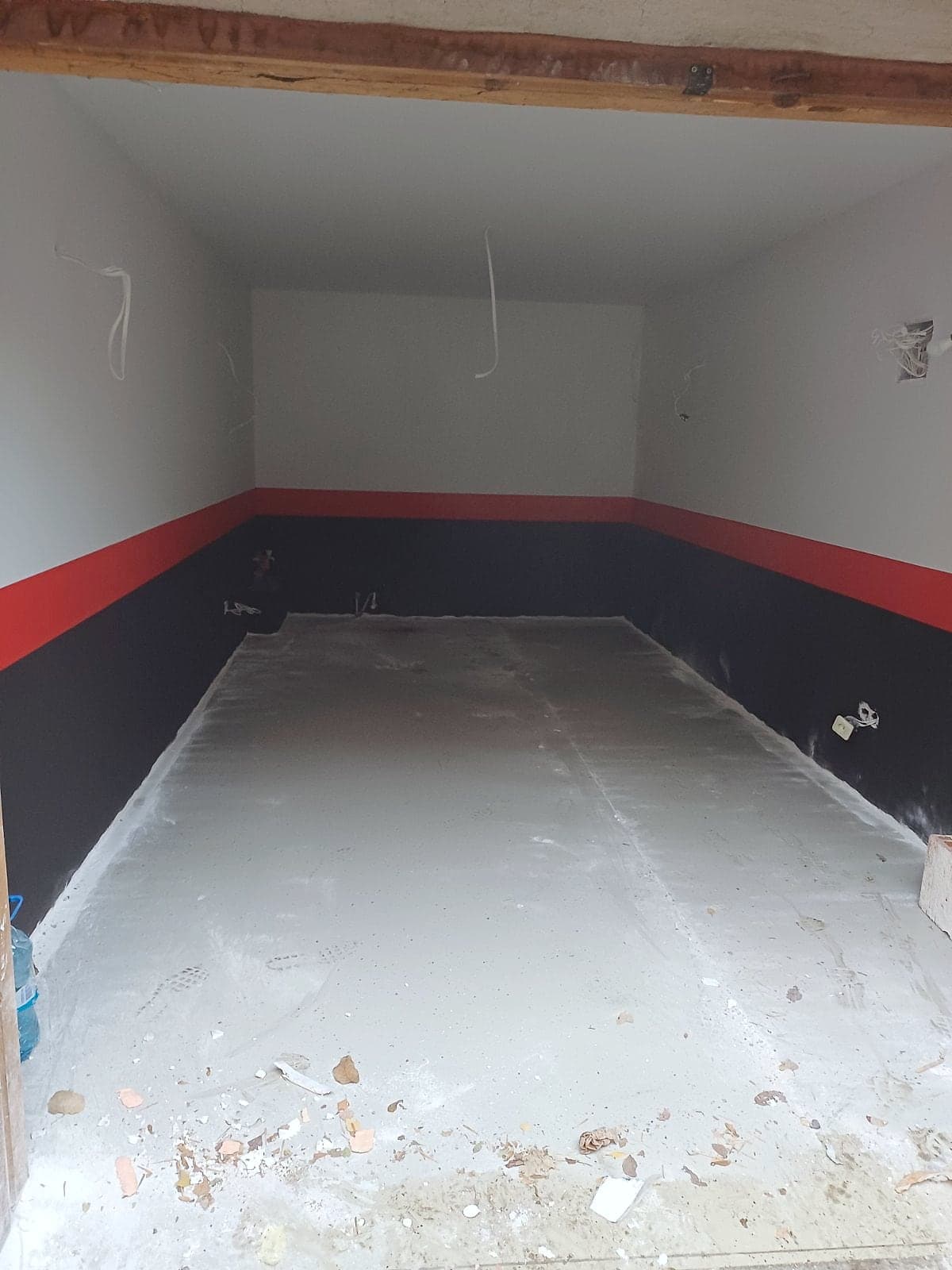 After
AfterThe most common preparation oversights are covered in the article on common painting mistakes. With wallpaper, the consequences are similar – stains, bubbles and peeling edges.
Paper, non-woven or vinyl wallpaper
The type of wallpaper determines how it is hung, where it is suitable and how it will come off years later. The essentials are shown on the roll label – in words or as symbols.
- Paper – the simplest type. The adhesive is applied to the wallpaper, which is then left for a few minutes to absorb the moisture before it goes on the wall. It lets water vapour through, but it is sensitive to water and rubbing; most paper wallpapers are not washable. It comes off after soaking, often in pieces.
- Non-woven – the material does not swell with the adhesive or shrink as it dries, so the seams stay tight. The adhesive usually goes on the wall and the wallpaper is hung dry. Later, it can often be stripped dry, in whole strips. There are also paintable non-woven wallpapers.
- Vinyl – a top layer of vinyl on a paper or non-woven backing. It is washable and hard-wearing, which makes it suitable for hallways, kitchens and children’s rooms. It lets almost no water vapour through: on a damp wall or in a poorly ventilated room, the moisture stays trapped behind it.
The backing also determines how the wallpaper is hung: vinyl on a non-woven backing is usually hung like non-woven wallpaper. On the label, also check whether the wallpaper is washable and what the pattern repeat is – it determines how many rolls you need to buy.
How many rolls you need
A standard roll is 0.53 m wide and 10.05 m long; there are also wide rolls, 1.06 m across. It is more accurate to work out the quantity by strips rather than by square metres, because every strip has to be trimmed and matched.
- The number of strips is the width of the wall divided by the width of the roll, rounded up. For a 3.5 m wall: 3.5 ÷ 0.53 = 6.6, so 7 strips.
- The length of one strip is the wall height plus about 10 cm for trimming at the top and bottom, plus one pattern repeat if the pattern needs matching. For a height of 2.6 m and a 53 cm repeat: 2.6 + 0.1 + 0.53 = 3.23 m.
- The number of strips per roll is the roll length divided by the strip length, rounded down: 10.05 ÷ 3.23 = 3.1, so 3 strips.
- The number of rolls is the total number of strips divided by the strips per roll, rounded up: 7 ÷ 3 = 2.3, so 3 rolls.
The pattern repeat is the vertical distance after which the design starts again. It is a straight match when the pattern continues into the next strip at the same height, and an offset (drop) match when the next strip is shifted – usually by half a repeat. Wallpaper with no repeat, such as one with a uniform background, does not need matching, and there is less waste.
On a taller wall, the repeat changes the calculation. If the wall is 2.8 m high, each strip becomes 3.43 m and a roll yields only 2 strips – you need 4 rolls, whereas without a repeat 3 would be enough.
This calculation includes a margin: some of the waste can be saved when cutting, but it is better to have a roll left over than to be one short. Buy all the rolls at once and from the same batch – the batch number is on the label, and different batches can vary slightly in shade.
How the wallpaper is hung
The hanging itself is the quick part, but it comes with details that set good work apart:
- The power to the sockets and switches on the wall is switched off and their cover plates are removed. The wallpaper is cut out around them in place, and the plates go back on over it.
- The first strip is hung to a plumb line or a laser level, not to the corner – corners are rarely perfectly vertical, and the error carries over into every strip that follows.
- The strips are butted edge to edge, without overlapping, with the pattern matched. Air is pushed out with a smoothing spatula, from the centre towards the edges.
- In corners, the strip is not wrapped all the way round – the next one starts again from a plumb line.
- At the top and bottom, the wallpaper is trimmed along the ceiling and the skirting board, and any excess adhesive is wiped off straight away, while it is still wet.
- While the wallpaper dries, the room is kept free of draughts and no heating is directed at the walls – otherwise the seams may open up.
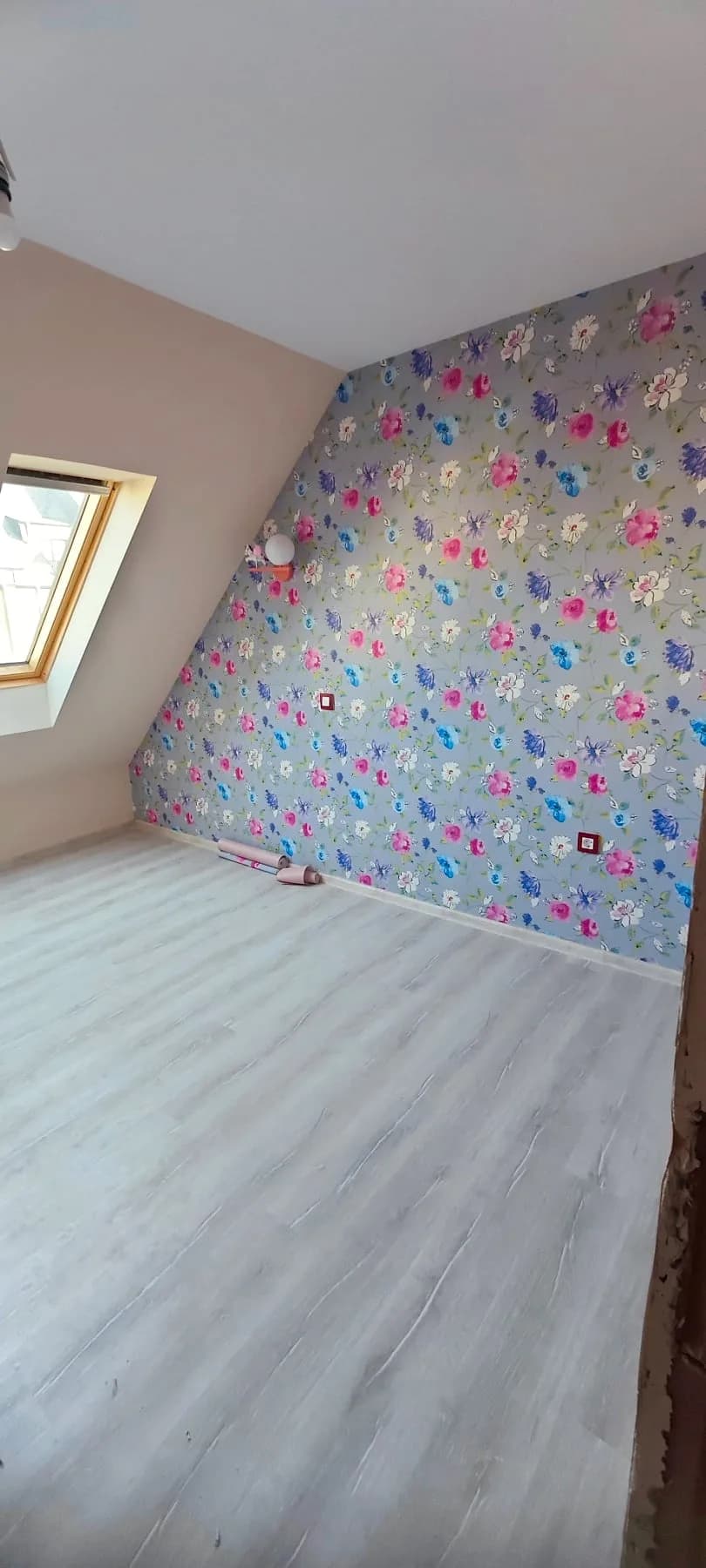
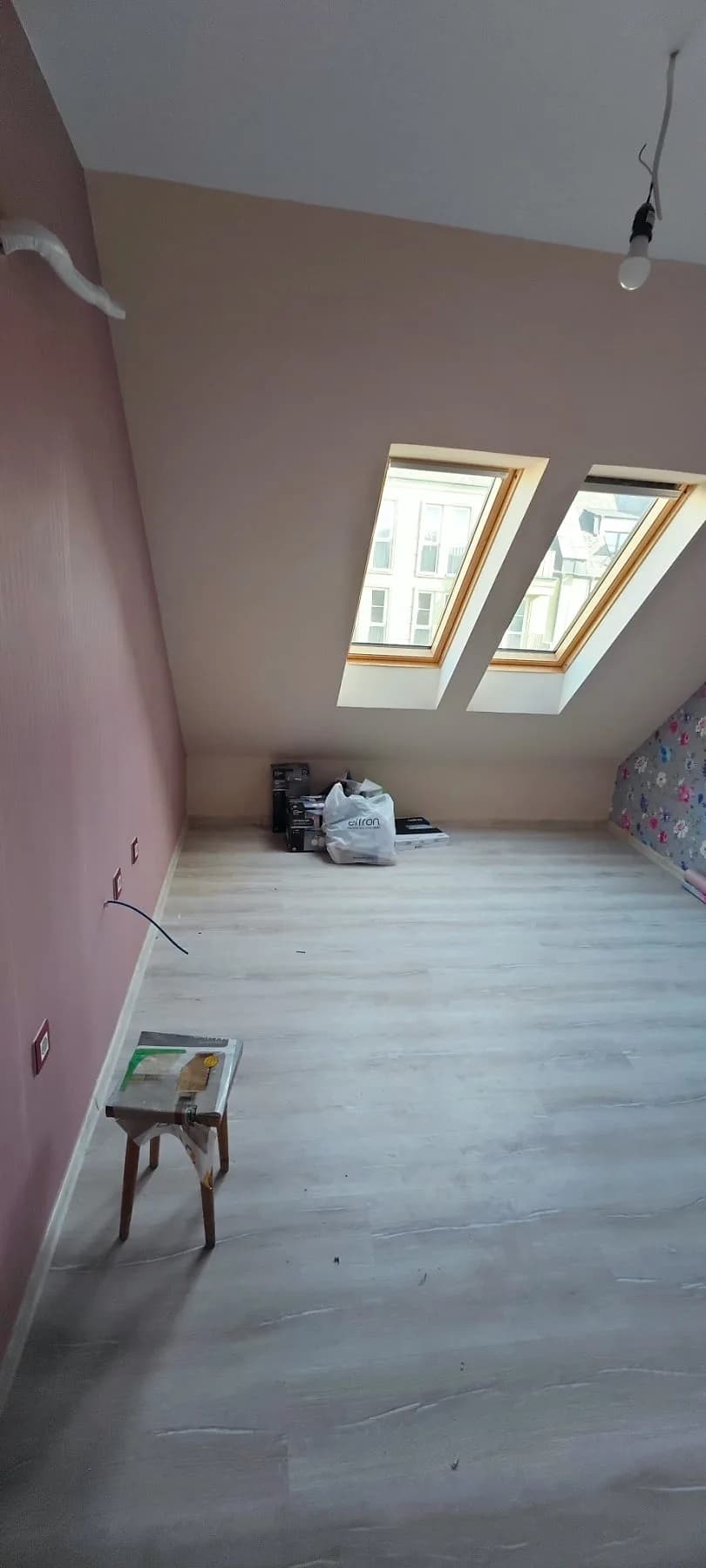
The finished wall is easy to check: the seams are invisible and have not opened, the pattern matches at every seam, there are no bubbles or creases, the edges at the ceiling and skirting board are straight and there are no adhesive marks on the surface. Bubbles and marks are easiest to see when the light comes from the side.
Alternatives: liquid wallpaper and paint
Liquid wallpaper
Liquid wallpaper does not come in rolls. It is a dry mix of fibres – cellulose, cotton or silk – and a binder. It is mixed with water and applied with a trowel, like a thin plaster. Labour is €10.00 per m² – for the example wall, 9.1 m² × €10.00 = €91.00 for labour, plus the preparation.
- There are no seams and no pattern repeat, so it works well on walls with lots of angles, niches and arches.
- A damaged spot is repaired locally: the area is moistened and scraped off, and fresh mix is applied.
- It usually does not tolerate wet cleaning and is not suitable for wet areas.
- It dries more slowly than paint – exactly how long depends on the product and the ventilation.
- The base also has to be sound, primed and an even, light colour, and any metal parts (nails, screws) must be sealed so that rust does not bleed through.
Paint
If you are torn between wallpaper and paint, compare the labour for the same wall: the price-list item ‘2 coats of paint – 1 colour’ is €6.44 per m², so 9.1 m² × €6.44 = €58.60 for labour, compared with €100.10 for hanging wallpaper. The preparation under both is similar, so the difference is in the final layer.
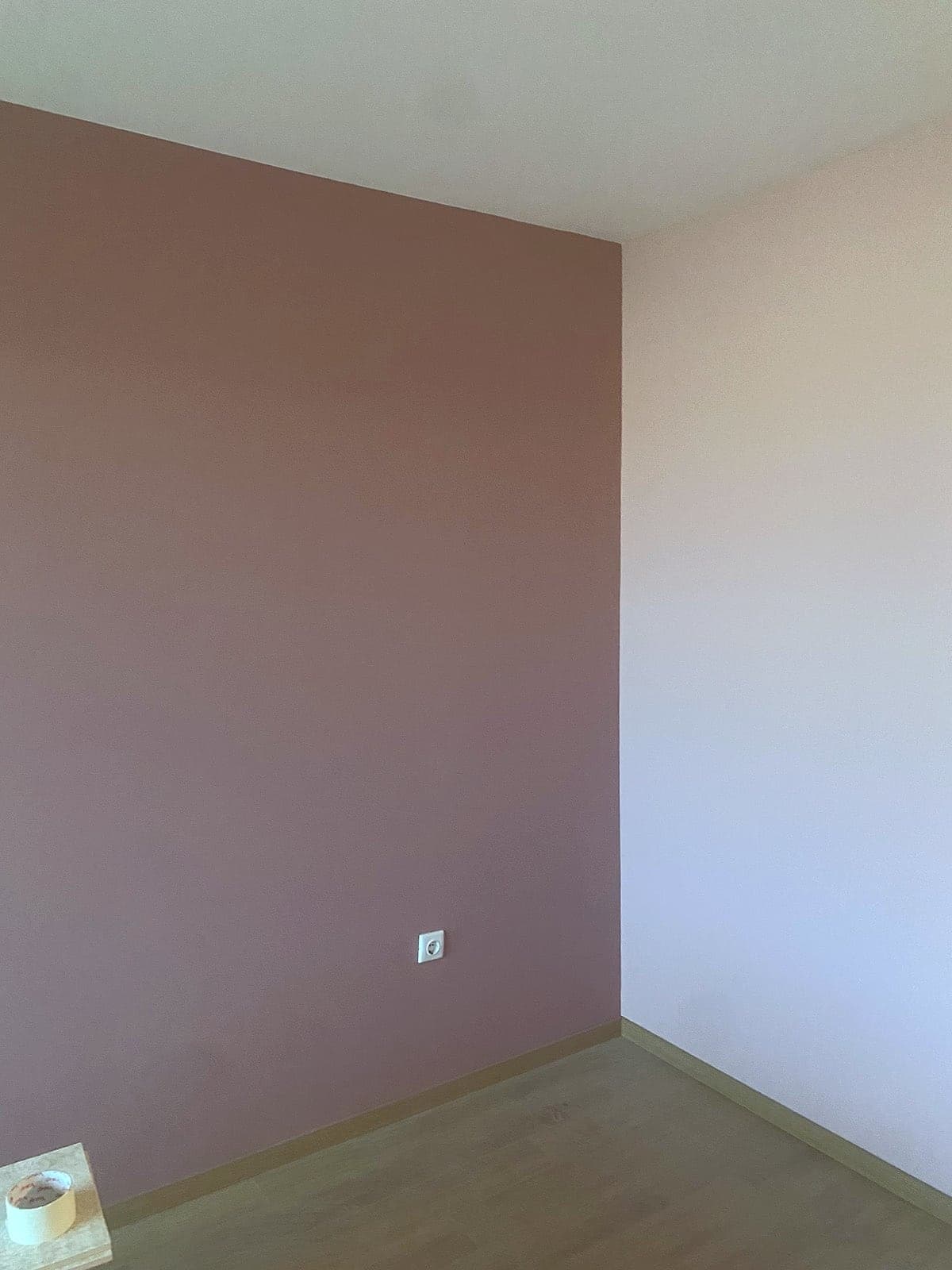
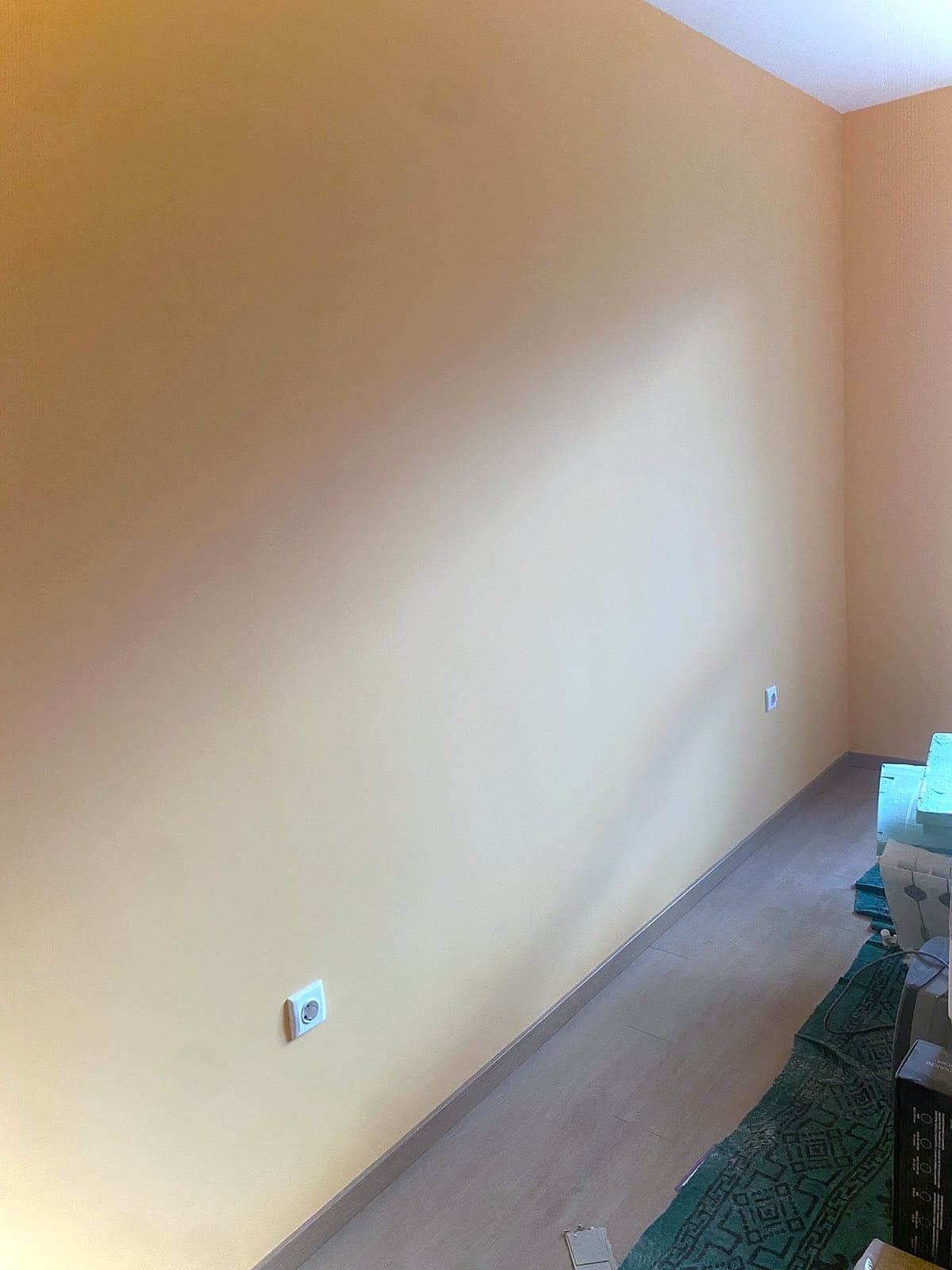
The two are not mutually exclusive: the wallpaper can go on just one feature wall, with the others painted. Colour itself can also give a room character, as in the apartment with walls in colour. The pros and cons of each option are covered in the article paint or wallpaper, and the painting page explains how we work with paint.
Frequently asked questions
Can you hang wallpaper over paint?
Yes, if the paint is sound and well bonded. The test is simple: stick on a piece of sticky tape and pull it off sharply – if any paint comes off on the tape, the wall is cleaned back to a sound surface and skim coated. Adhesive grips poorly on glossy oil-based paint, so it is sanded back to a matt finish or removed. The wall is primed before hanging.
Does the old wallpaper have to come off?
Yes. The new adhesive soaks the old wallpaper, which can then come away together with the new one, and the old seams show through. Stripping costs €4.60 per m² for labour; afterwards, the wall often needs at least partial skim coating.
How long does wallpaper last?
It depends more on the wall and the room than on the wallpaper itself. In a dry room, on a sound, primed base, non-woven and vinyl wallpapers last a long time. The first signs of trouble are usually peeling edges and seams opening up – most often caused by damp or skipped preparation. Direct sunlight fades the design over time; lightfastness is also shown on the label.
Can you use wallpaper in a kitchen or bathroom?
In a kitchen, choose washable vinyl wallpaper and keep it away from the sink and the hob – tiles or glass are better behind them. In a bathroom, use only wallpaper designed for humid rooms, outside the splash zone and with good ventilation. The shower and the area around the bath call for tiles over waterproofing.
Who buys the wallpaper?
We agree on this in the quote. You usually choose the design; if you buy the wallpaper yourself, work out the number of rolls as described above and get them all from the same batch. The adhesive and primer are construction materials and appear in our quote on a separate line from the labour.
How much does it cost to wallpaper one wall?
For a 3.5 × 2.6 m wall (9.1 m²), labour is €112.29 if the wall is smooth and sound, and €236.87 if it first needs two skim coats and sanding. Stripping old wallpaper adds €41.86 for labour. The wallpaper and materials are not included, and the line-by-line calculation is in the example above.
If you want an exact price for your walls, book a site visit – it is free, and the quote is in writing, with the work and the price set out. We reply to enquiries within 24 hours. If the wallpaper is part of a larger renovation, you can also get a first indication through a photo estimate.
More articles
All articles Finishing work
11 min read
Suspended ceiling with LED lighting: types, labour cost and examples
The types of suspended ceiling, what the labour costs and a worked example for a 16 m² room with LED strip and downlights – plus what to decide first.
Read Finishing work
11 min read
Plaster prices 2026 (labour): sand-finish, Venetian, travertine
Labour per m² for gypsum, lime-cement, sand-finish and Venetian plaster and silicone render, what the preparation adds and a worked example.
Read Finishing work
9 min read
How to avoid the most common mistakes when painting an apartment
At first glance, painting an apartment looks like an easy, manageable job, but in practice it often turns out to be a test full of pitfalls. Many owners decide to freshen up the walls and ceilings themselves, but seemingly minor oversights can lead to serious disappointment. The consequences can be patchy coverage, stains, peeling, cracking or even a colour that does not match the original idea.
Read