Small bathrooms of 2–4 m²: ideas from our projects and what they cost
Walk-in showers, wall-hung toilets, niches and larger tiles in 2–4 m² bathrooms: when they work, how they look in our projects and what they cost.
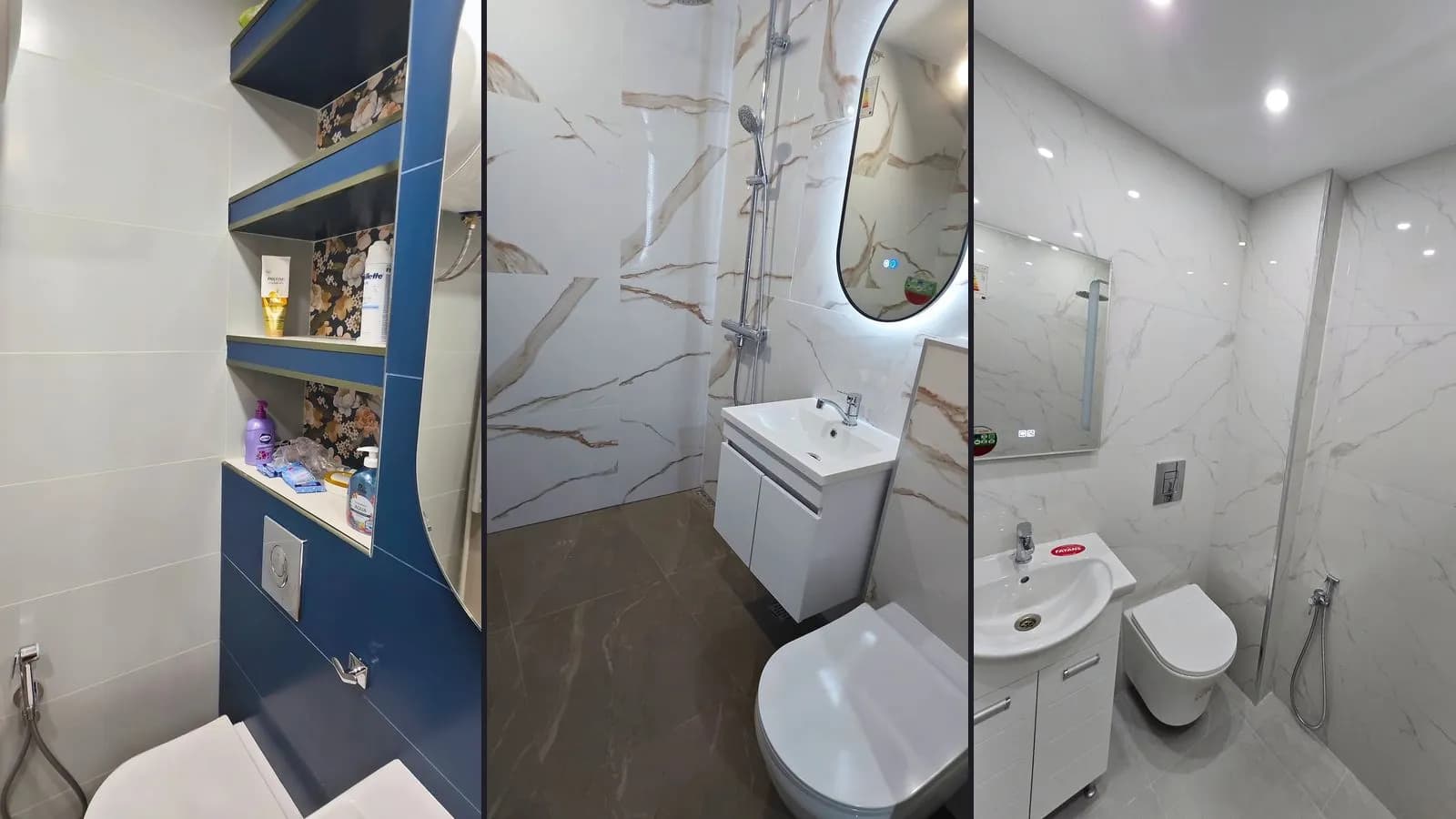
A full renovation of a small bathroom costs roughly €3,900 for a 2 m² bathroom, about €4,485 for 3 m² and €5,000 for 4 m². These figures include the labour and the construction materials, at the standard level and for Sofia, with a range of ±10%; you buy the tiles and sanitaryware yourself. A bathroom with half the floor area does not cost half as much – the reason is explained below.
In a small bathroom, you gain space through the layout: a floor-level shower instead of a bath, a wall-hung toilet, niches instead of cabinets. The sense of space comes from larger tiles and a bright ceiling. Below are the solutions we suggest most often, shown in bathrooms from our projects, and when each of them makes sense.
If you are looking for ideas on colours and style, see 10 modern design ideas for a small bathroom. This article is about the practical side: what each solution requires and how much the labour costs.
A walk-in shower with a linear drain instead of a bath
The bath is the largest item in a bathroom, and in a small room it dictates everything else: where the basin goes, how far the door opens, whether there is room for a washing machine. A floor-level shower frees up that space and is easier to use – there is no edge to step over.
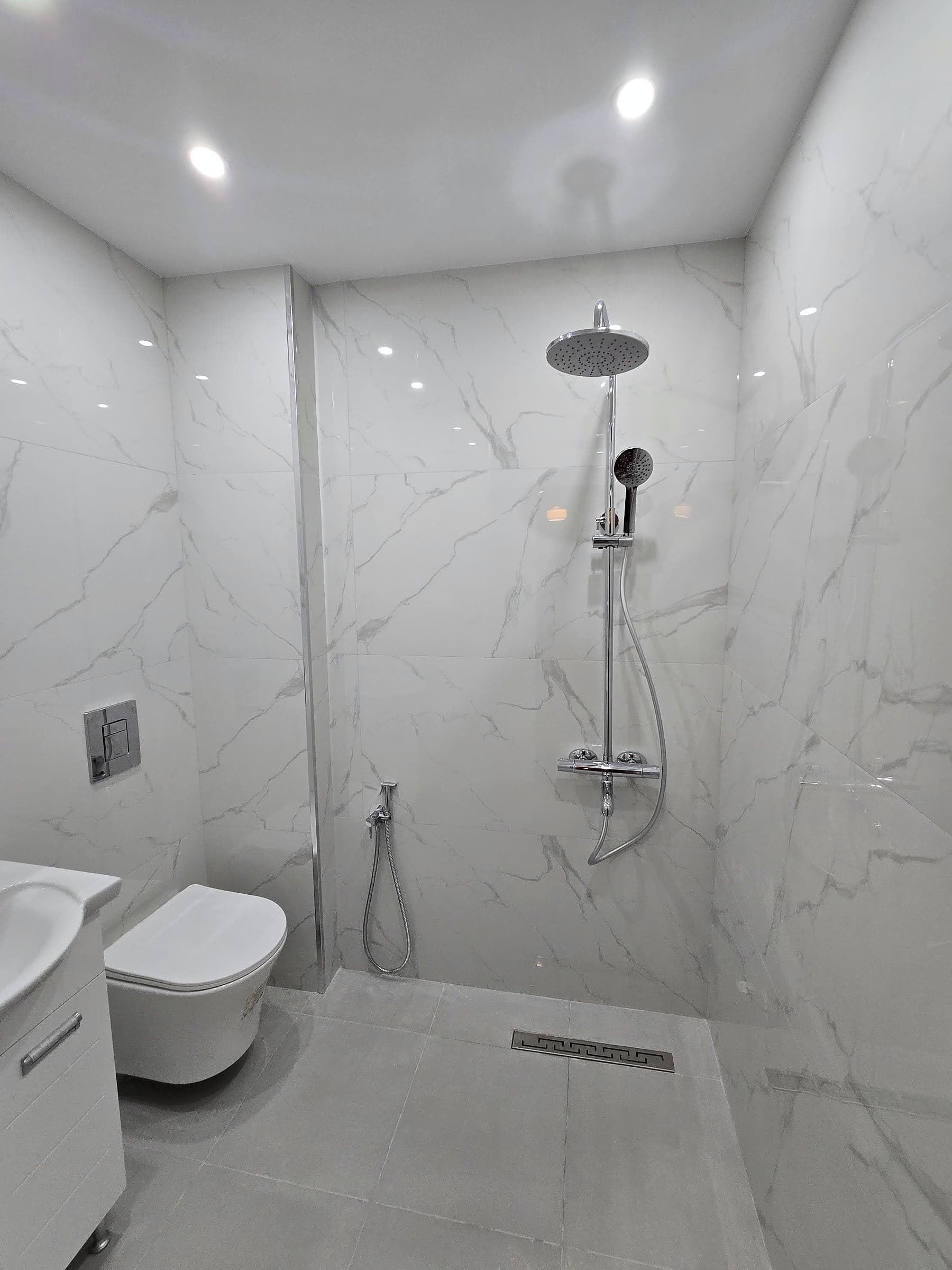
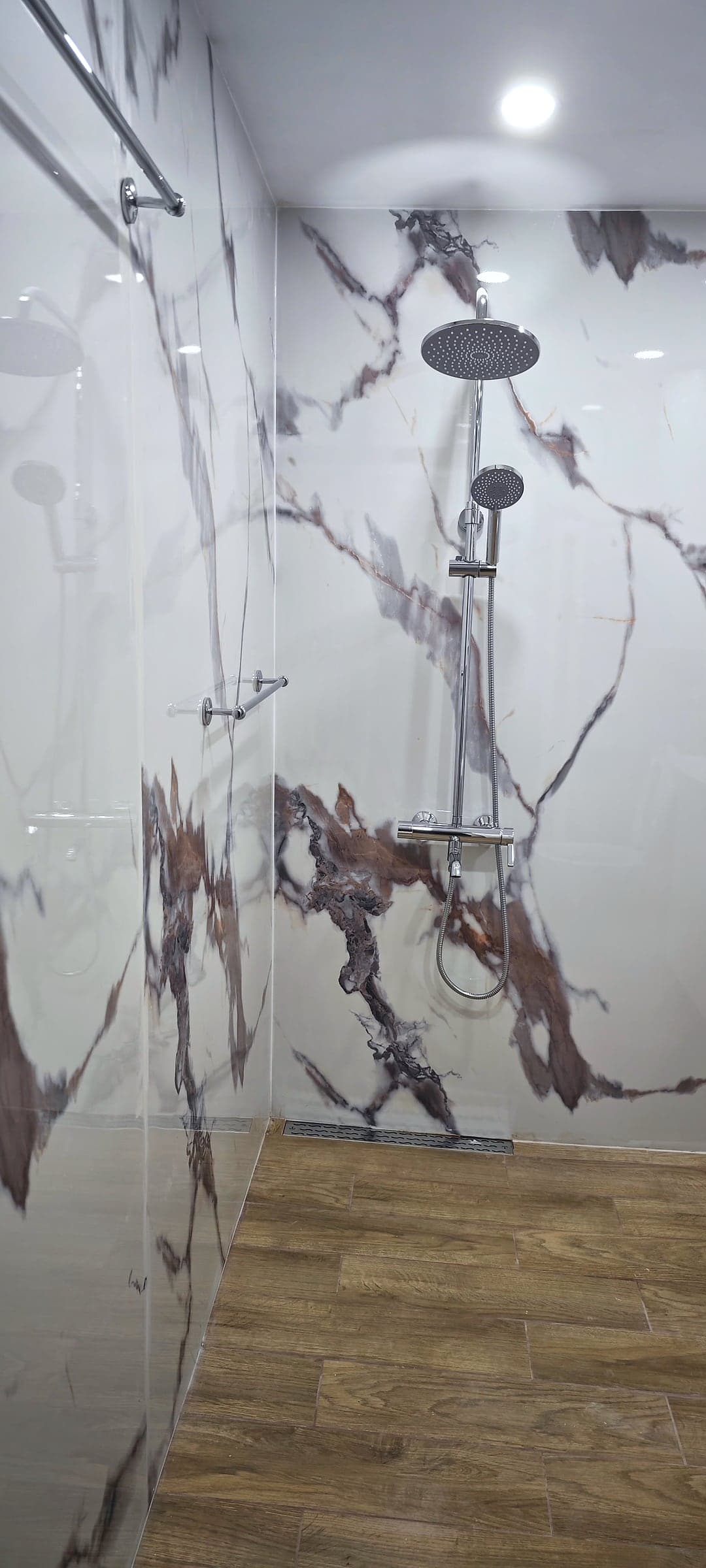
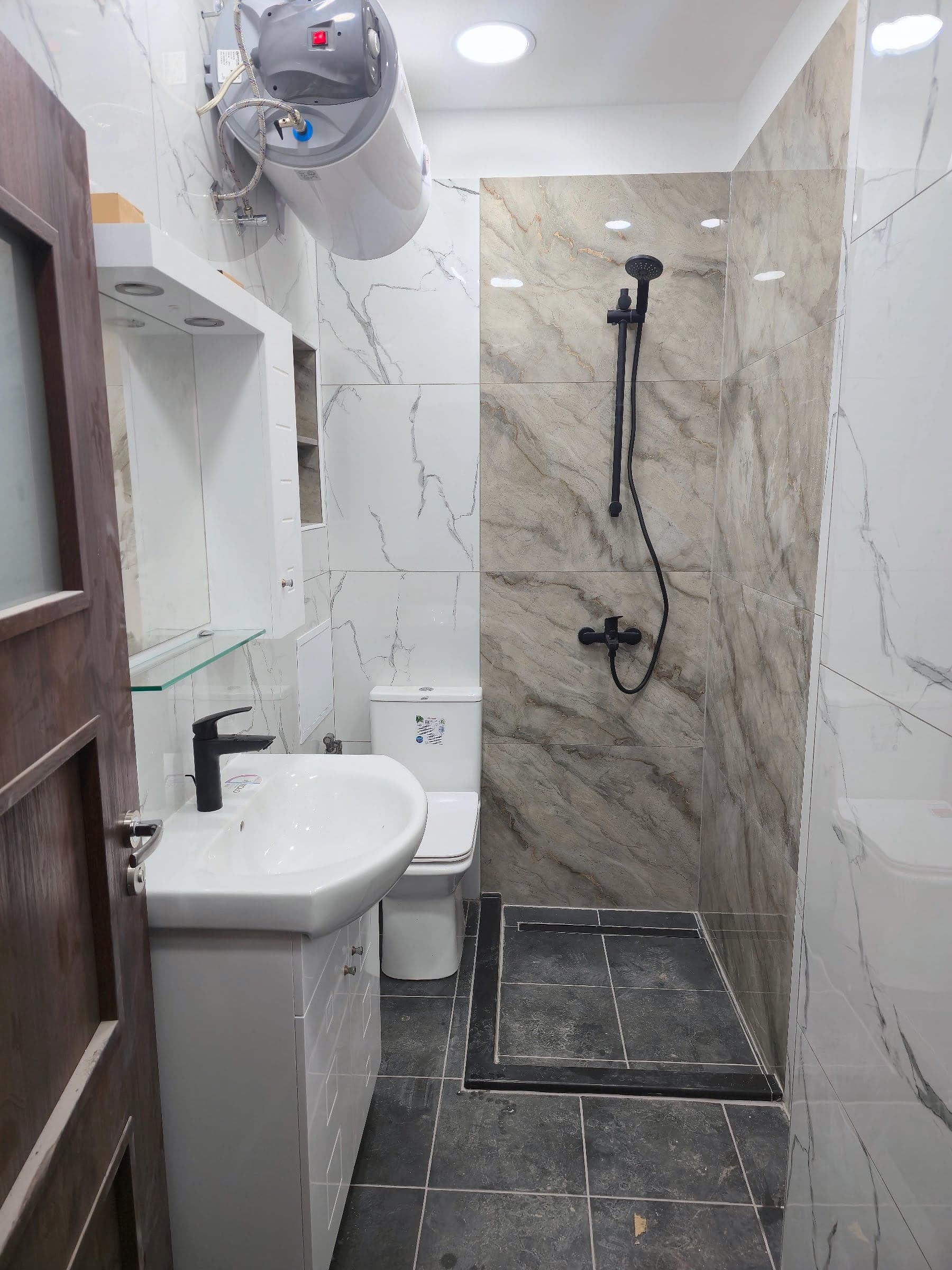
The floor of the shower area is laid to a fall towards the drain, and the waterproofing covers the whole floor, not just the shower. When the linear drain runs along the wall, the floor slopes in one direction only, so larger tiles can be laid on it too. The shower can be separated off with a glass screen, as in the bathroom in Levski G in the photo below.
Labour prices from the price list: installing a linear drain – €59.05, installing a concealed shower – €107.37, fitting a shower screen – €96.63. If an old bath is being taken out, removing it costs €53.69 for labour.
Whether the shower can be level with the floor, with no threshold, depends on where the drainage is and how much the floor can be raised to create the fall. This is assessed at the site visit, and sometimes only becomes clear after the demolition. If it cannot be done, the shower is built with a threshold.
A wall-hung toilet with shelves above it
With a wall-hung toilet, the cistern and pipes sit in a metal frame behind a boxing-in of moisture-resistant plasterboard and tiles. Only the toilet and the flush plate remain visible. The floor beneath it is clear and easy to clean, and the bathroom looks more spacious.
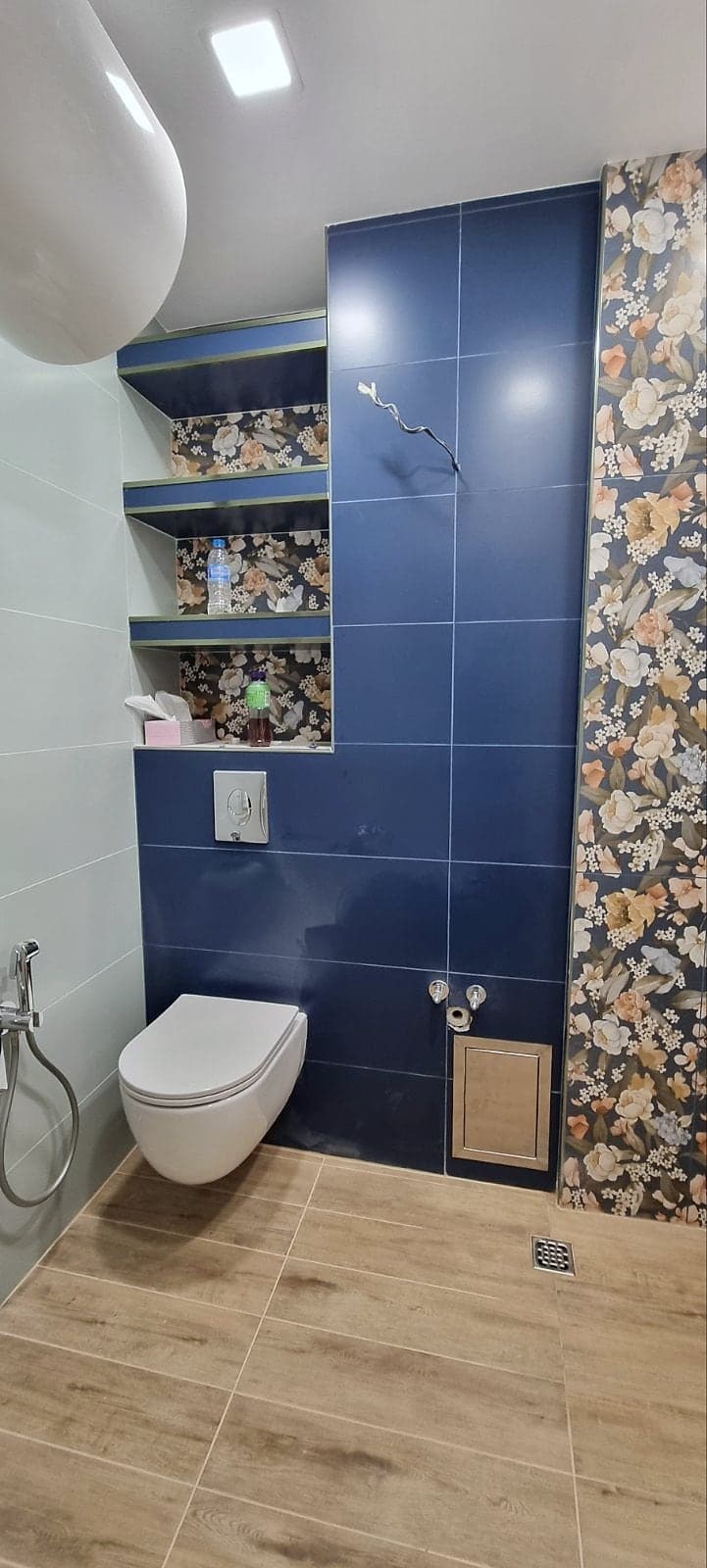
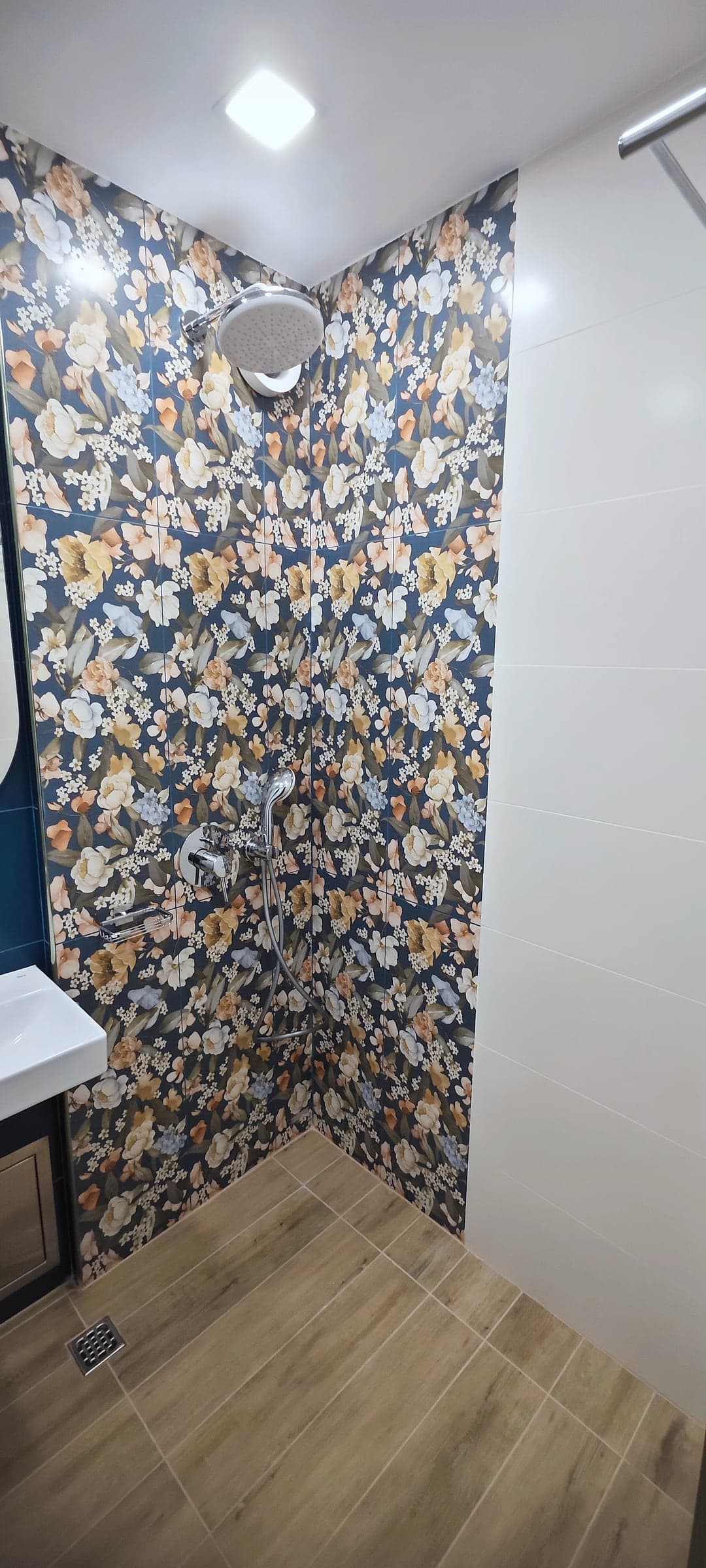
The wall around the frame is being built from scratch anyway, so it is easy to form shelves or a niche above the toilet. In the bathroom in Suhata Reka, there are built-in shelves above the toilet, backed with the same floral tiles as in the shower: things have their place, and no cabinet sticks out into the room.
The hidden valves and connections must remain accessible, so an access panel is left in the tiling – in the same bathroom, it is to the right of the toilet, close to the floor. Fitting an access panel costs €42.95 for labour.
Labour for a wall-hung toilet comes as two items: installing the concealed frame + boxing it in with plasterboard – €187.90, and fitting the wall-hung toilet – €59.05. A close-coupled toilet is the simpler option: fitting one costs €42.95 for labour and needs no frame – there is one in the narrow white and grey marble bathroom a little further down.
Basin, mirror and niches
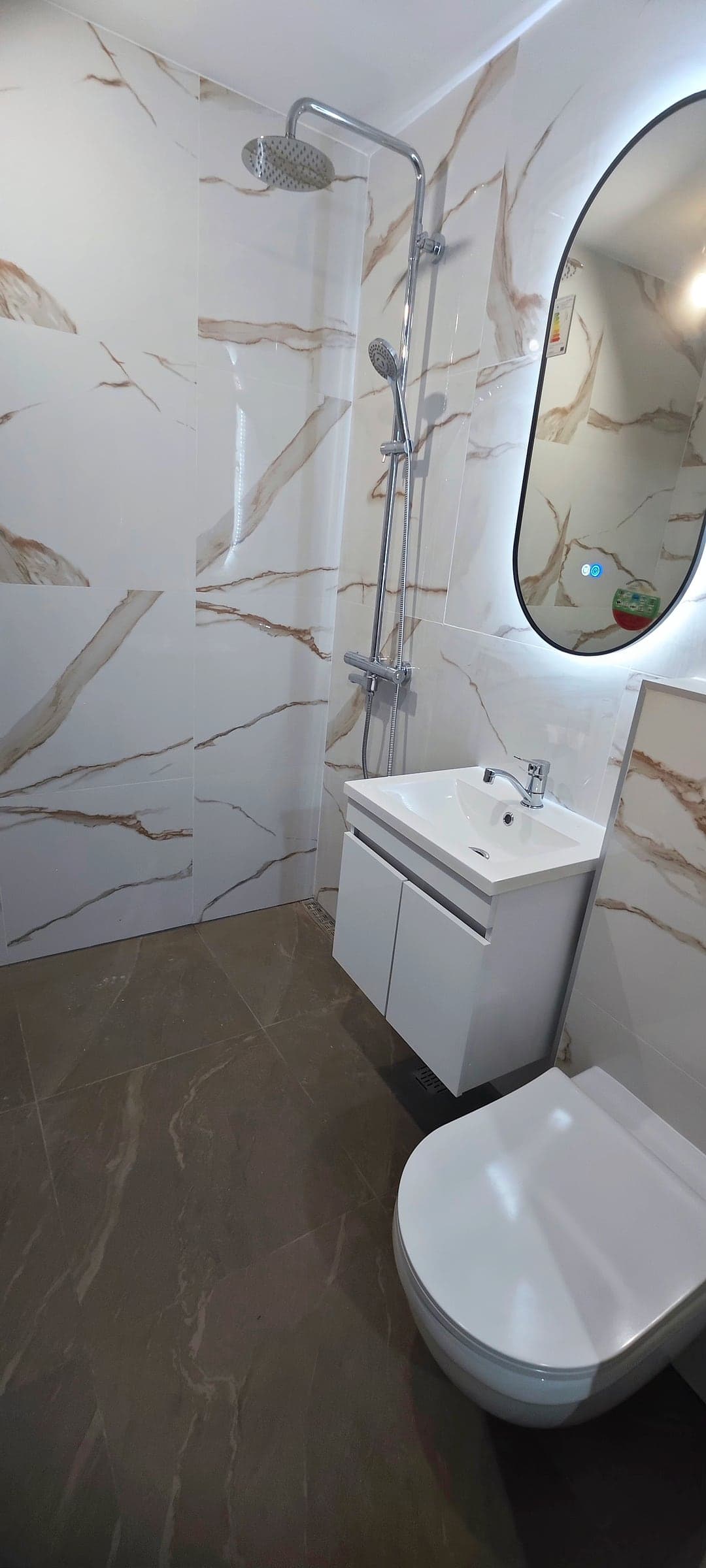
A vanity unit stores everything under the basin that would otherwise sit on the floor or on the edge of the bath. A wall-hung vanity unit leaves the floor beneath it clear, so the bathroom looks wider; a wall-mounted basin without a cabinet is the most compact option, but offers no storage space.
Above the basin, a mirror cabinet adds storage without taking up floor space, and a backlit mirror lights the face evenly. A cabinet with built-in lights and an LED mirror both need an electrical point behind them, so their position is decided before the tiling. Labour from the price list: fitting a vanity unit – €59.05, a mirror cabinet – €50.00, an LED mirror – €48.32, an electrical point – €32.21.
A niche is a shelf that does not stick out. It is formed in a brick wall or in plasterboard boxing-in; a load-bearing concrete wall must not be weakened by a niche. According to the price list, cutting an opening for a niche in a brick wall costs €107.37, building a niche from plasterboard €140.00, and lining it with tiles (‘tiling the niche returns’) €107.37 – all for labour.
Where to put the water heater
In a small bathroom, the water heater usually goes up high – above the toilet, the basin or the door, where it is out of the way. In the narrow white and grey marble bathroom, it sits under the ceiling, above the basin (the left-hand photo above).
Its position is decided before the tiling, because the water connections and the power supply run inside the wall. Its valves must be accessible, and the heater itself must be removable for replacement. If there is no room in the bathroom, it can go outside it, for example in the hallway, but then new pipe runs to the bathroom are needed. Labour prices: installing a water heater – €80.53, running water heater connections chased into the wall – €129.92.
Larger tiles and a bright ceiling
The fewer the grout lines, the calmer the wall looks and the easier it is to clean. Light-coloured, larger tiles with thin grout lines make a small bathroom look bigger. In the bathroom in Levski G, the shower walls are clad in very large marble-effect tiles, with only a few grout lines across them.
Large format comes at a price, too. A large tile needs a very flat wall, it is heavier and there is more cutting around the pipes – and a small bathroom has plenty of corners and outlets. That is why the calculator places large format in the premium level, together with mosaic and complex detailing.
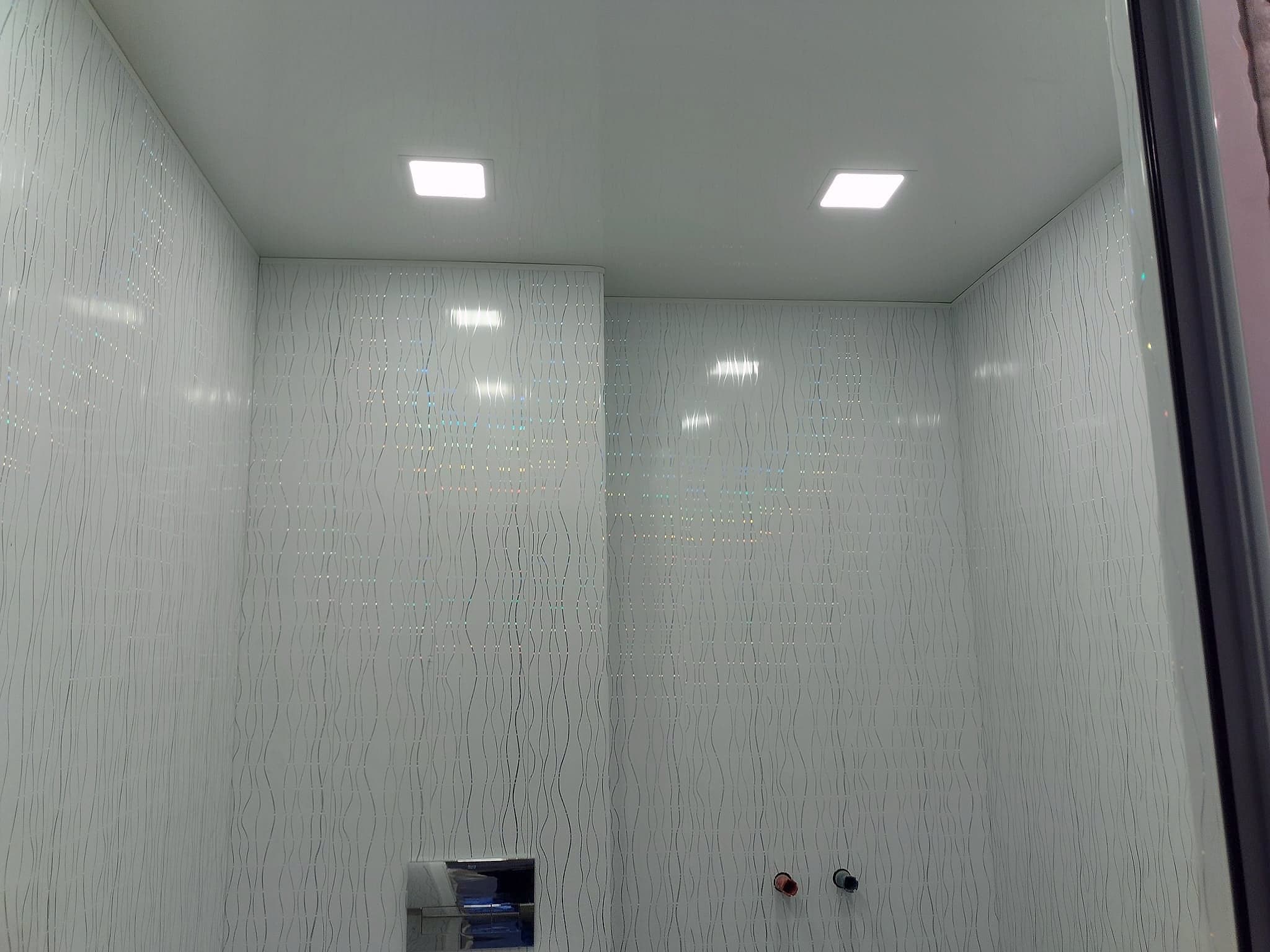
When renovating a bathroom, we usually put in a suspended ceiling of moisture-resistant plasterboard. The cables and the extractor fan duct can run above it, and downlights or LED panels are set into it. Several recessed lights give even lighting and leave no dark corners – important in a bathroom without a window.
An extractor fan is not a luxury: a small bathroom gets damp quickly, and without extraction, mould appears in the corners and along the grout lines. Fitting one costs €26.84 for labour.
According to the price list, a suspended ceiling for a bathroom (‘Plasterboard suspended ceiling (bathroom/toilet)’) costs €161.06 for labour, and each downlight €8.05 for the wiring and €10.74 for fitting. A ceiling with four downlights comes to €161.06 + 4 × (€8.05 + €10.74) = €236.22 for labour.
What bathrooms of 2, 3 and 4 m² cost
The calculator works out the cost from the tiled area, not just the floor. It assumes a square bathroom with the walls tiled up to 2.5 m: the tiled area is the floor plus the four walls (floor + 4 × √floor × 2.5 m). A fixed part is added to the cost of the tiling – the installation of the sanitaryware, the plumbing and electrical points, the ceiling and the waste removal. At the standard level for Sofia, it works out at €1,640 plus €140 for every m² of tiles, including the construction materials; for other cities, the calculator uses lower prices.
| Bathroom floor | Tiled area (floor + walls) | Cost (€1,640 + €140 × m² of tiles) | Range (±10%) |
|---|---|---|---|
| 2 m² | ≈ 16.14 m² | ≈ €3,900 | €3,510–4,290 |
| 3 m² | ≈ 20.32 m² | ≈ €4,485 | €4,037–4,934 |
| 4 m² | 24 m² | €5,000 | €4,500–5,500 |
Why is a small bathroom not proportionally cheaper? First, the fixed part does not depend on the area: the shower, toilet, basin, pipes and electrical points are the same in 2 m² as in 4 m². Second, the walls shrink more slowly than the floor: with a 4 m² floor, there are 24 m² of tiles, and with a 2 m² floor, about 16 m². The floor area is halved, but the cost is only about €1,100 less.
The level in the calculator describes how complex the work is, not the class of materials. Basic means no plumbing or electrical points are moved and the tiles are a standard format; premium involves complex detailing – large format or mosaic, precise joints and corners.
The standard level is based on the real cost of an old bathroom: for 4 m², it is usually €4,500–5,500 including the construction materials, because the demolition uncovers things that cannot be seen beforehand – crooked walls, old pipes, screed repairs, corrections. We describe what hides under old tiles in our article on renovating an old bathroom, and the price of each job separately in bathroom labour costs, task by task.
These figures include the construction materials – adhesives, waterproofing, screeds, profiles, plasterboard; in our written quote they are a separate line. The tiles, sanitaryware and drains are not included – you choose and buy them yourself. Prices are as of October 2026 and may change.
Frequently asked questions
Shower or bath in a 3 m² bathroom?
If nobody at home is set on having a bath, a floor-level shower is usually the better choice: the space it frees up is often enough for a washing machine or a larger vanity unit. A bath makes sense if you bathe a small child or enjoy a long soak; in that case, choose a shorter bath with a bath screen.
How much does it cost to renovate a 2 m² bathroom?
By the calculator’s formula, it comes to about €3,900 at the standard level, with a range of €3,510–4,290: €1,640 plus 16.14 m² of tiles × €140. That includes the labour and the construction materials. The smallest bathroom area in the calculator on our website is 3 m², so this figure was worked out by hand. The tiles and sanitaryware are separate, and the exact price comes after a site visit.
Can a washing machine fit in a small bathroom?
Yes, if its place is planned before the tiling. A washing machine needs a water supply, a waste outlet and a socket; the connections are made together with the other plumbing work, and the socket is an electrical point – €32.21 for labour. The usual places are under a worktop next to the basin or in a niche; which of these is possible depends on the door and on where the pipes can run.
Which tiles make a bathroom look bigger?
Light-coloured, larger tiles with thin grout lines work best, with only a few colours and decorative tiles in the mix. When the floor and walls are in the same colour range, the boundaries blur and the room looks bigger. If you want a decorative tile, put it on one wall – in the shower, for example.
How long does the renovation take?
It usually takes 2–3 weeks of work (10–15 working days) for a 3–5 m² bathroom, including the waiting time for the screed and the waterproofing to dry. A smaller area mainly shortens the tiling – drying time does not depend on the floor area. The stages, day by day, are in the article how long a bathroom renovation takes, and the exact schedule is in the quote.
If you are wondering which of these solutions are possible in your bathroom, the quickest way to find out is a site visit. It is free: we measure the room, check where the riser and the connections are, and you receive a written quote listing the work and the price. How we work on small bathrooms is described on the small bathroom renovation page; we reply to enquiries within 24 hours.
More articles
All articles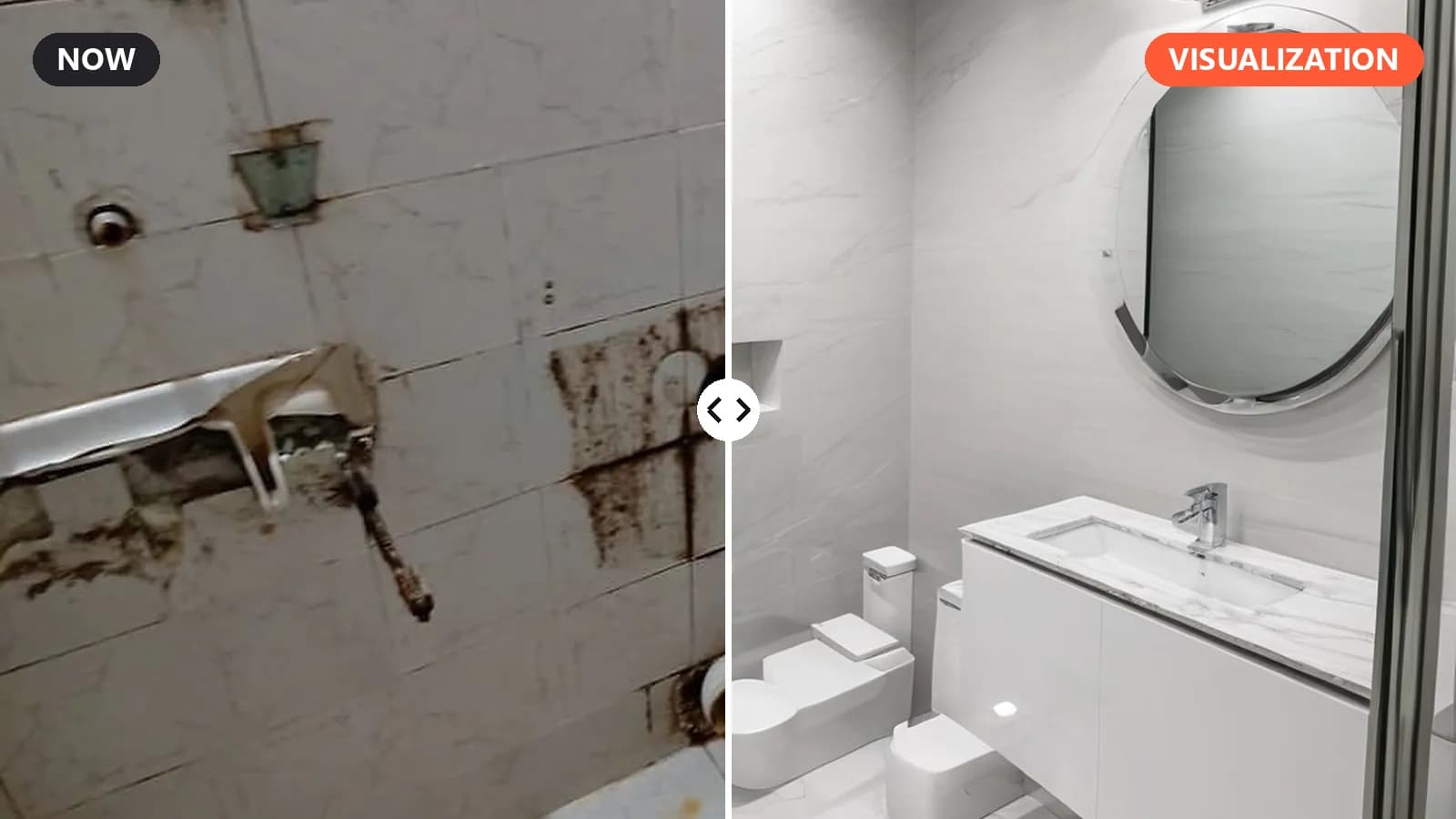 Bathroom
2 min read
New: see your new bathroom before the renovation
Upload a photo of your bathroom as it is now and in about a minute you will see it renovated in three styles – white marble, warm wood and dark stone. Free, no sign-up.
Read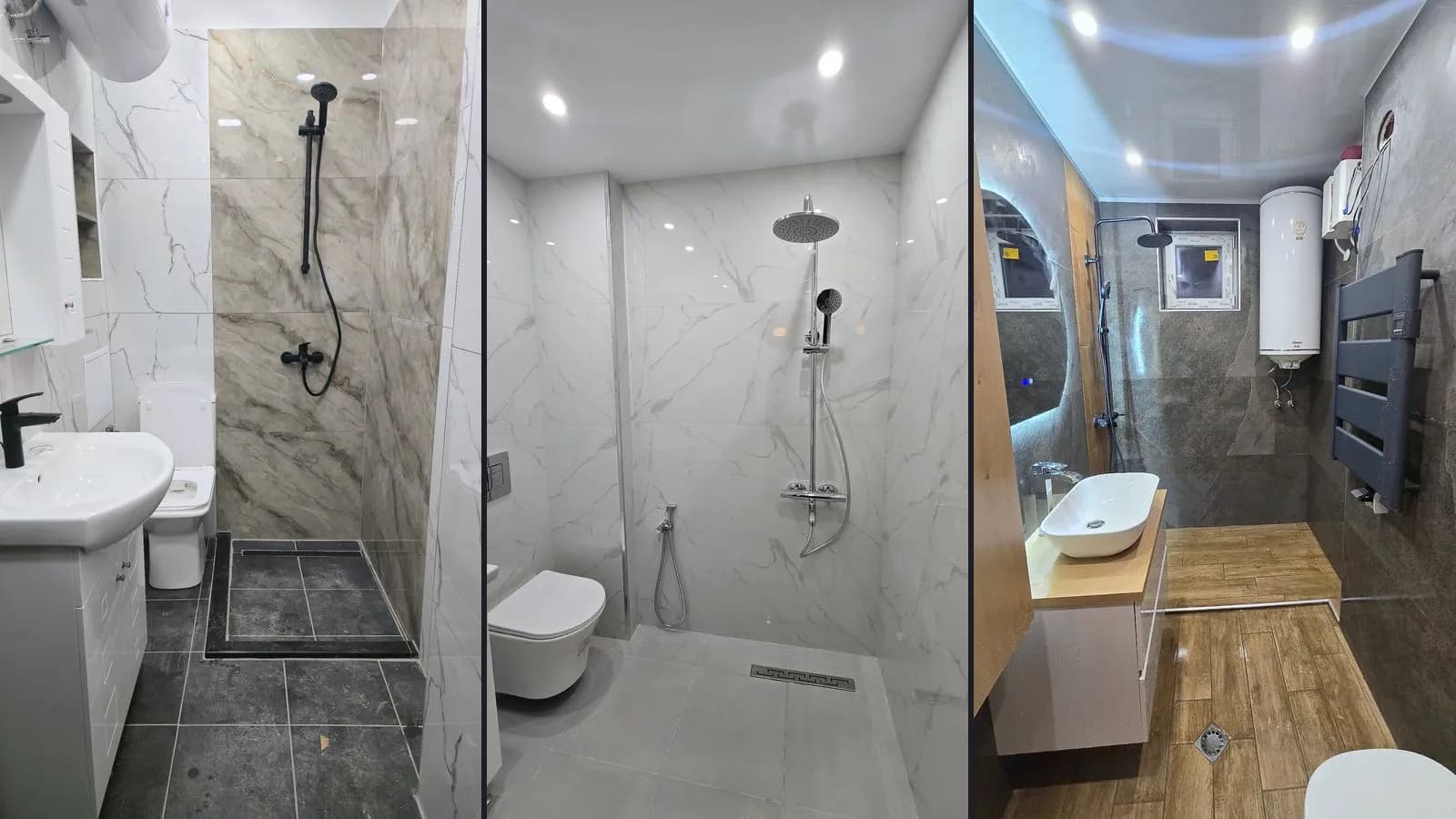 Bathroom
12 min read
Bathroom renovation: labour costs in 2026, task by task
Bathroom labour prices task by task, a worked example for 4 m² and why an old bathroom usually comes to €4,500–5,500 with construction materials.
Read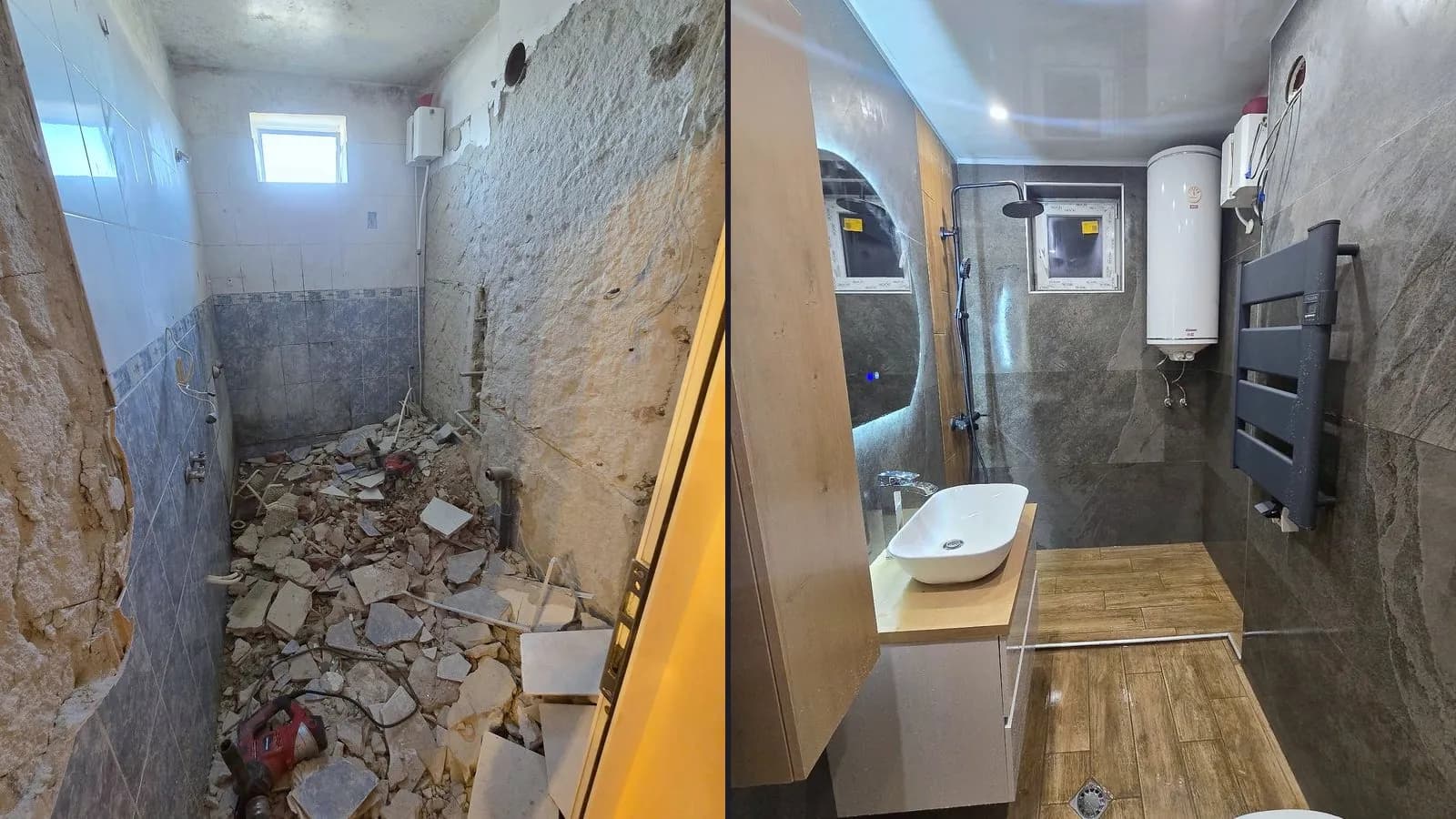 Bathroom
9 min read
Renovating an old bathroom: what the tiles hide – before and after
What turns up when an old bathroom is stripped out, what to change while the walls are open, what it costs – and our bathrooms before and after.
Read