Plasterboard prices 2026: walls, linings, ceilings and niches
Plasterboard labour prices per m² – partition walls, linings, suspended ceilings and niches – with worked examples for a wall and a 16 m² ceiling.
Free site visit and quote
Leave your phone – we will call you
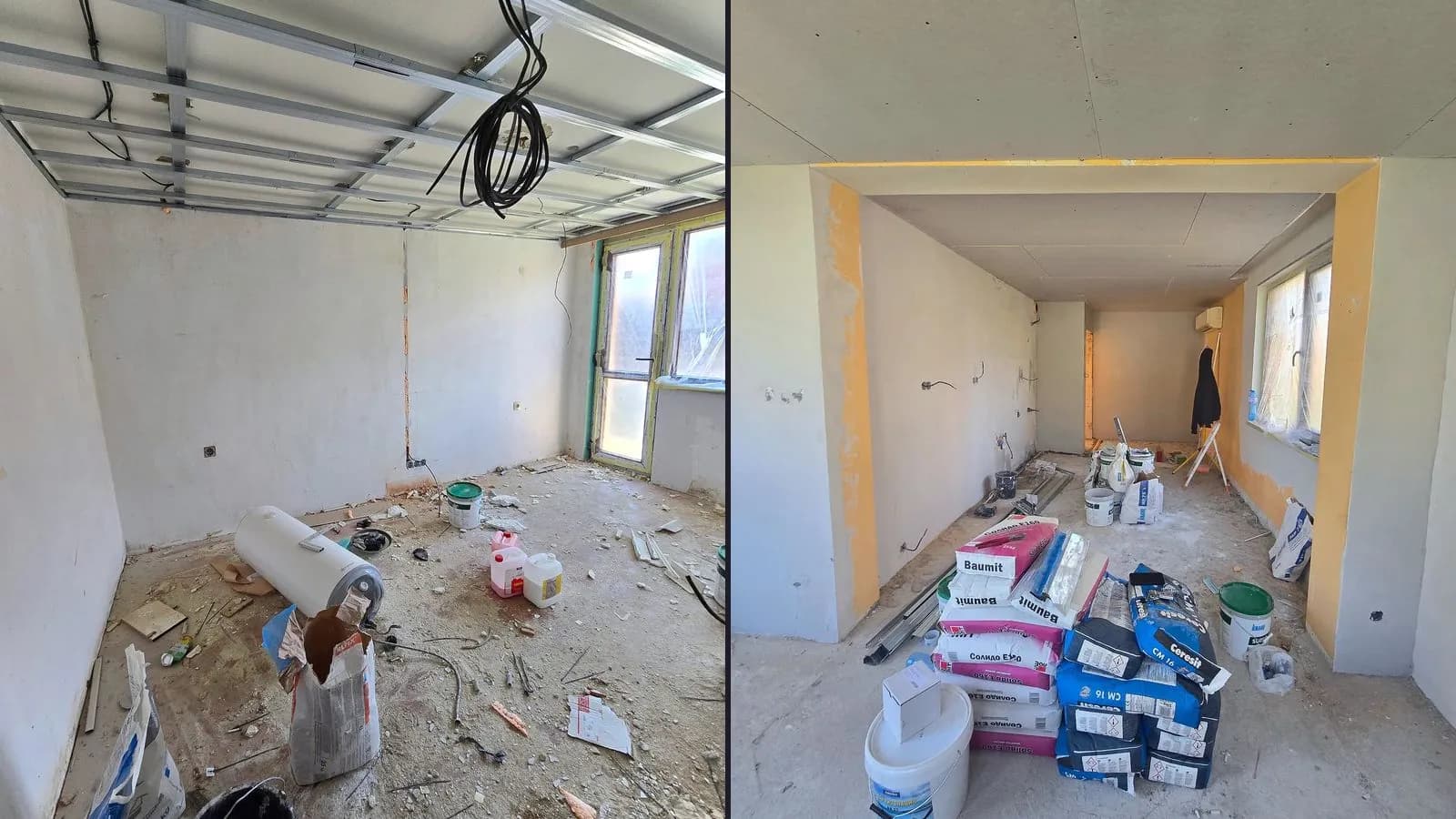
In drywall work, labour is priced per m²: €18.79 for a single-level plasterboard suspended ceiling, €24.16 to €34.90 for a partition wall, depending on how it is built, and €21.47 or €24.16 for a wall lining with mineral wool. Niches and openings are priced per item – a plasterboard niche, for example, is €140.00 for labour.
A 3.5 × 2.6 m partition wall with mineral wool costs €219.86 for labour, or €728.00 with jointing, skim coat and paint on both sides. A suspended ceiling without lighting for a 16 m² room, finished and painted, comes to €747.36 for labour.
The prices are from our price list as of October 2026 and may change. Materials are not included: the profiles, plasterboard, mesh and primers appear on a separate line in our quote.
Prices for partition walls and wall linings
A partition wall stands on its own: a metal frame closed with plasterboard on both sides. A wall lining sits in front of an existing wall – to straighten it, to hide pipes and cables or to add mineral wool. The item names follow our price list, with the abbreviation for plasterboard written out in full.
| Price-list item | Price for labour |
|---|---|
| Building a partition wall – plasterboard | €26.84 per m² |
| Plasterboard partition wall, 12.5 cm, with mineral wool – Knauf type (7.5 cm profile, 2 layers of plasterboard) | €24.16 per m² |
| Moisture-resistant plasterboard partition wall, 10 cm, with mineral wool – Knauf type (5 cm profile, 2 layers of moisture-resistant plasterboard) | €24.16 per m² |
| Building a frame – wall – double plasterboard, 12 cm (both sides) + mineral wool | €26.84 per m² |
| Building a plasterboard partition wall + tape and mineral wool | €32.21 per m² |
| Building a double partition wall – plasterboard + mineral wool | €34.90 per m² |
| Plasterboard wall lining – 6.25 cm, with mineral wool – Knauf type (5 cm profile, 1 layer of plasterboard) | €21.47 per m² |
| Plasterboard wall lining – 7.5 cm, with mineral wool – Knauf type (5 cm profile, 2 layers of plasterboard) | €24.16 per m² |
| Wall lining in moisture-resistant plasterboard – 7.5 cm, with mineral wool – Knauf type (5 cm profile, 2 layers of moisture-resistant plasterboard) | €24.16 per m² |
| Plasterboard wall lining – 10 cm, with mineral wool – Knauf type (7.5 cm profile, 2 layers of plasterboard) | €24.16 per m² |
| Plasterboard / bonding | €18.79 per m² |
In the Knauf-type items, the number is the total thickness: the profile plus the boards, each 1.25 cm thick. The 7.5 cm lining, for example, is a 5 cm profile and two layers of plasterboard, and the 12.5 cm wall is a 7.5 cm profile with two layers on each side. That is the least the room loses along the lined wall.
‘Plasterboard / bonding’ involves no frame: the boards are bonded straight onto the wall. This loses the least space, but the wall underneath has to be sound, and there is no cavity left behind the boards for pipes or mineral wool.
Some items overlap. The price list also has more general ones: ‘Plasterboard / frame (walls)’ – €21.47, ‘Plasterboard frame + mineral wool’ – €24.16 and ‘Double plasterboard / frame’ – €26.84 per m² for labour. We state which item applies to your wall in the written quote after the site visit. One item also includes the materials: ‘Building a plasterboard wall lining / labour and materials’ – €32.21 per m² including materials.
For ideas on partitions, niches and zoning, see the article on plasterboard in modern interiors; how we work is described on the plasterboard in Sofia page.
Prices for suspended ceilings
A suspended ceiling is a metal frame below the concrete slab or below the roof, closed with plasterboard. The price depends on the frame and on whether there is mineral wool above the boards:
| Price-list item | Price for labour |
|---|---|
| Installing a suspended plasterboard ceiling | €18.79 per m² |
| Installing a suspended ceiling + mineral wool | €24.16 per m² |
| Installing a suspended ceiling on a double frame + mineral wool | €28.45 per m² |
| Installing a suspended ceiling + mineral wool / under the roof | €35.00 per m² |
| Installing a two-level suspended plasterboard ceiling with concealed lighting | €37.58 per m² |
| Plasterboard suspended ceiling (bathroom/toilet) | €190.00 each |
Mineral wool adds €24.16 − €18.79 = €5.37 per m² for labour. It makes sense under a roof, below a cold loft or against noise from the floor above. The types of ceiling – with mineral wool, on a double frame, on two levels, with concealed lighting – and the prices for the LED strip and downlights are covered in the article on suspended ceilings with LED lighting. Curved shapes are built to a drawing and priced on quote; how they are built is explained in the article on curved plasterboard forms.
The photos below are from the house in Obelya, where, besides the roof and the drainage, we also built suspended ceilings.
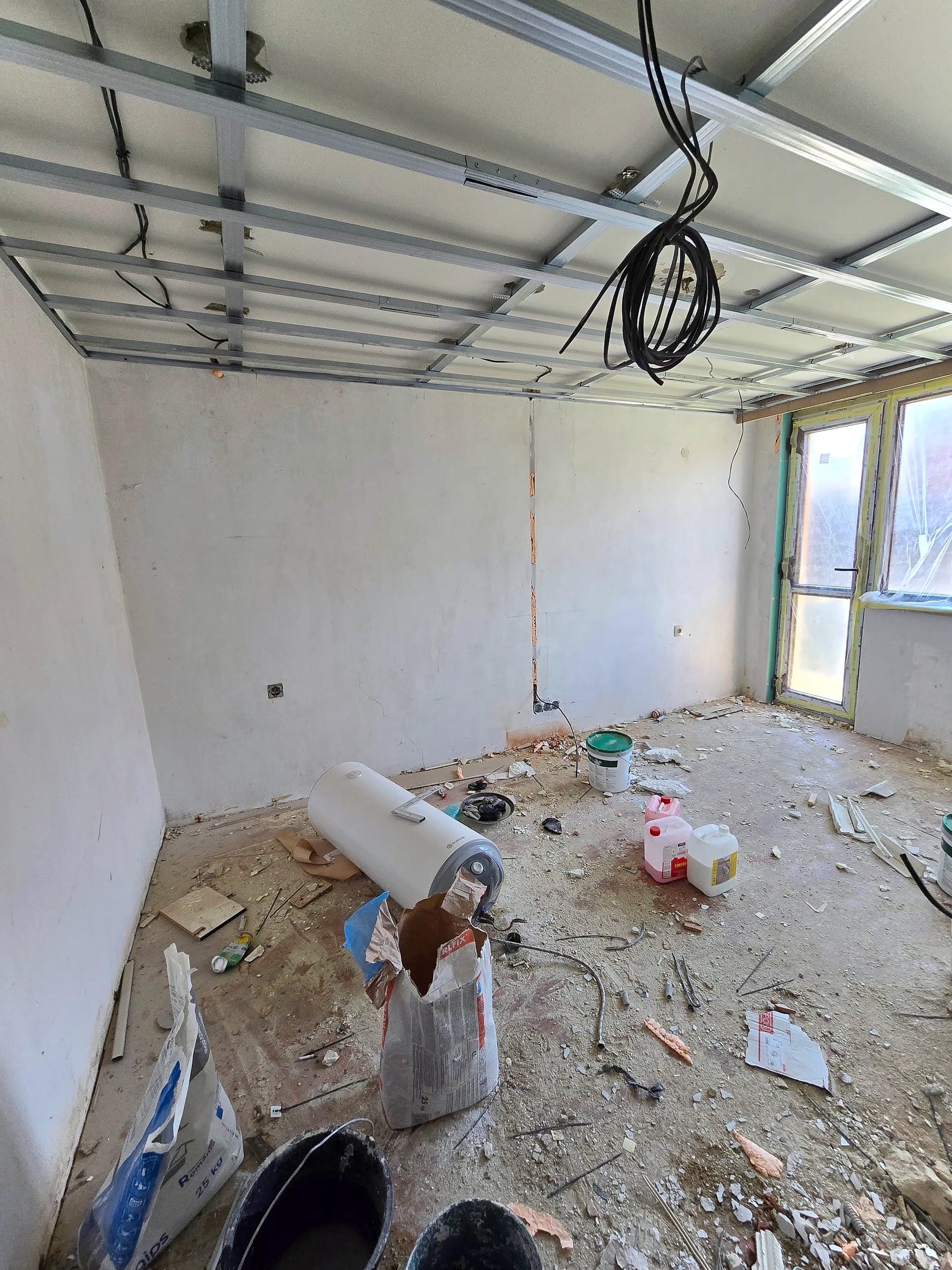 Frame
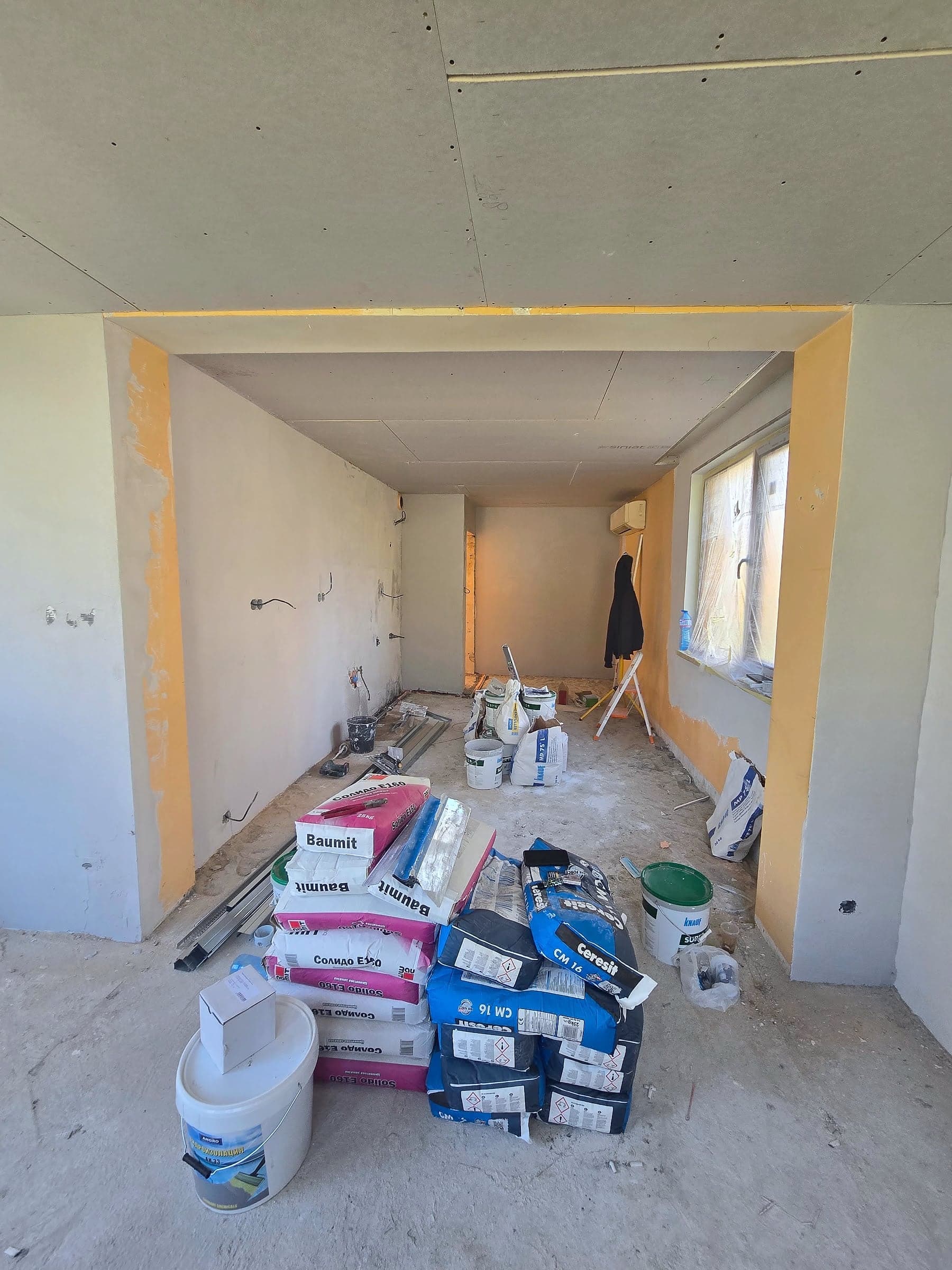 Closed up
Prices for niches, openings, boxing-in and finishing
Details are priced per item or per linear metre. Jointing, skim coating and painting are not included in the price of the wall or ceiling – they are separate items:
| Price-list item | Price for labour |
|---|---|
| Building plasterboard niches | €140.00 each |
| Closing up a niche with plasterboard | €53.69 each |
| Forming a door opening in plasterboard | €200.00 each |
| Boxing in a lintel with plasterboard | €18.79 per lin. m |
| Closing a wall opening with plasterboard + finishing | €64.42 each |
| Building plasterboard boxing – pipes + finishing + trims | €107.37 each |
| Bonding plasterboard to a chimney + finishing and trims | €96.63 each |
| Installing a concealed frame + plasterboard cladding | €187.90 each |
| Closing a riser opening with plasterboard | €64.42 each |
| Fitting an access panel | €42.95 each |
| Jointing plasterboard + mesh | €5.37 per m² |
| Primer before skim coat, 2 coats of skim, sanding, dust removal, primer before paint, 2 coats of paint | €22.55 per m² |
| Removing plasterboard + frame | €10.23 per m² |
| Removing a suspended plasterboard ceiling | €10.74 per m² |
Pipe boxing is a plasterboard box built around pipes. The concealed frame is the metal frame of a wall-hung toilet, with its cistern, and the item also covers cladding it with plasterboard. A lintel is the beam above an opening, and ‘boxing in a lintel’ means cladding it with plasterboard. In front of valves and water meters, an access panel is left in the lining, so that the plasterboard does not have to be cut open for every inspection.
Which plasterboard for what
Standard plasterboard is for dry areas – rooms, hallways and ceilings. Moisture-resistant plasterboard, usually green, is for bathrooms, toilets and kitchens, but it is not waterproofing. In wet areas, waterproofing is applied over it, with tape in the corners, and we test it with water before tiling.
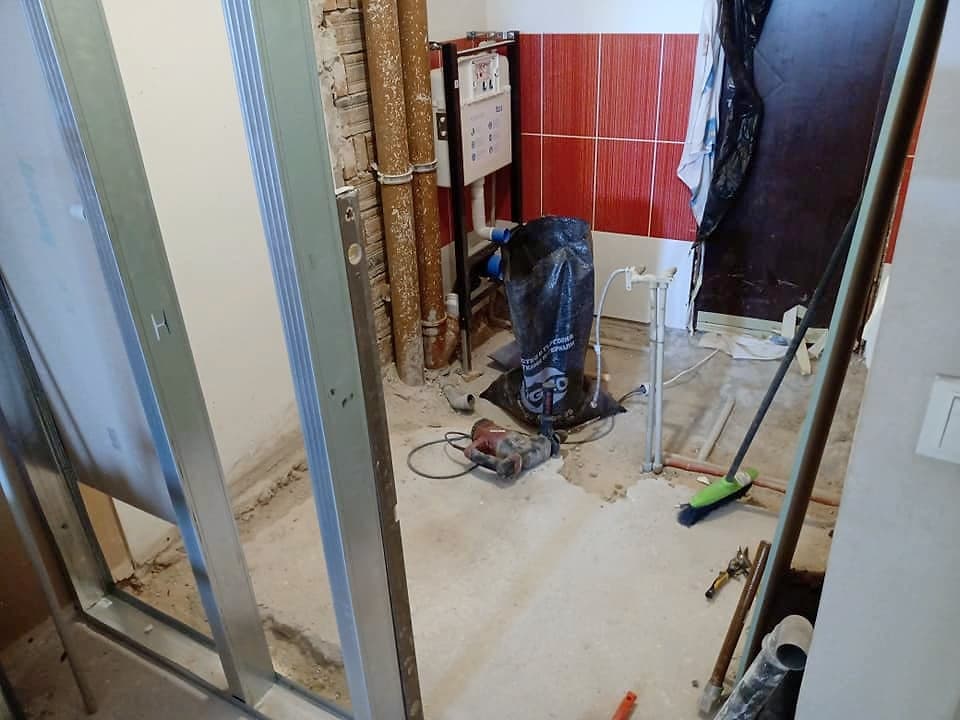
In a bathroom, a lining of moisture-resistant plasterboard hides the new pipes: in the beige and brown bathroom in the photo below, only the water outlets come through it. How the pipes, the lining and the toilet frame are arranged in a small bathroom is described in the article on bathroom renovation in a panel block.
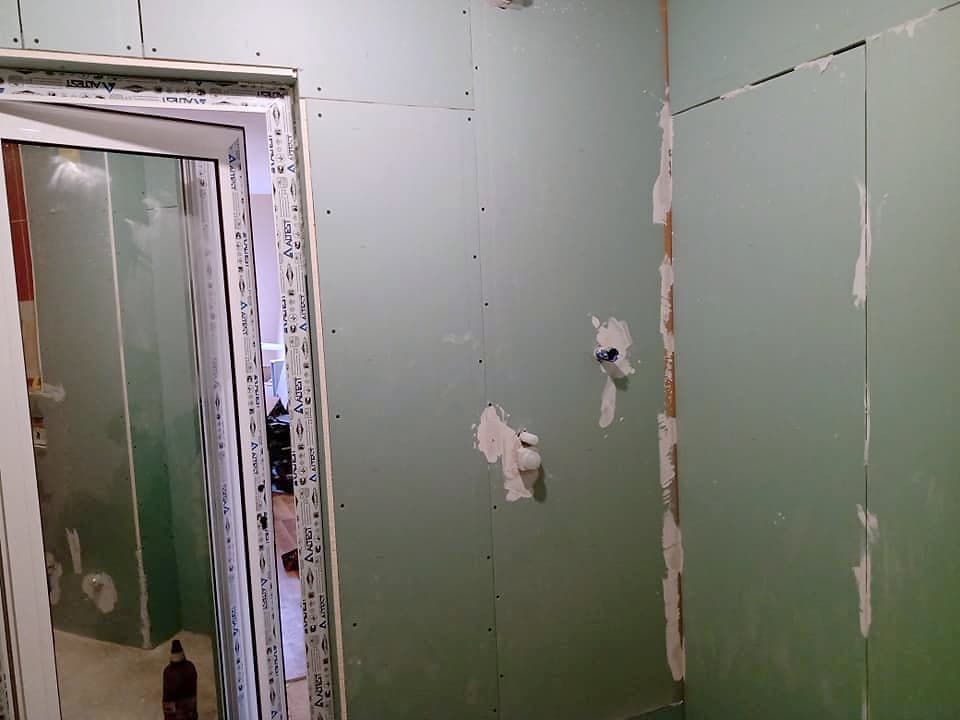
The second choice is the number of layers. Two layers of boards make the wall stronger and quieter; in the Knauf-type items, the number of layers is given in the name.
Sound insulation: what the mineral wool does
An empty cavity in a wall resonates. Mineral wool in the cavity absorbs sound, and a second layer of boards makes the wall heavier – both make it quieter. The wool is laid between the profiles before the wall is closed up on the second side.
It only helps if the sound has no easier way through:
- The wall goes up to the concrete slab, not just to the suspended ceiling – otherwise the sound passes over it.
- Gaps along the floor, walls and ceiling are filled – sound gets through them and bypasses the wool.
- Sockets on the two sides of the wall are not placed directly opposite each other.
Two worked examples
A 3.5 × 2.6 m partition wall with mineral wool
The wall is 3.5 m long and 2.6 m high, i.e. 9.1 m². We have used the item for a 12.5 cm wall with mineral wool and two layers of plasterboard on each side. The jointing, skim coat and paint are for both sides: 2 × 9.1 m² = 18.2 m².
| Work | Quantity | Price for labour |
|---|---|---|
| Plasterboard partition wall, 12.5 cm, with mineral wool – Knauf type (7.5 cm profile, 2 layers of plasterboard) – €24.16 per m² | 9.1 m² | €219.86 |
| Jointing plasterboard + mesh – €5.37 per m² | 18.2 m² | €97.73 |
| Primer before skim coat, 2 coats of skim, sanding, dust removal, primer before paint, 2 coats of paint – €22.55 per m² | 18.2 m² | €410.41 |
| Total | €728.00 |
The wall itself is €219.86 for labour, while finishing both sides comes to €97.73 + €410.41 = €508.14 for labour – more than the wall. If the wall has a door in it, add ‘Forming a door opening in plasterboard’ – €200.00 for labour; fitting the door itself is a separate item.
A suspended ceiling for a 16 m² room
The ceiling is on one level, with no mineral wool and no lighting. The frame and boards come to 16 m² × €18.79 = €300.64 for labour, the jointing with mesh to 16 m² × €5.37 = €85.92 for labour, and the skim coat and paint to 16 m² × €22.55 = €360.80 for labour. In total: €300.64 + €85.92 + €360.80 = €747.36 for labour.
With mineral wool (‘Installing a suspended ceiling + mineral wool’ – €24.16), the frame and boards come to 16 m² × €24.16 = €386.56, and the total to €386.56 + €85.92 + €360.80 = €833.28 for labour. The calculation for a two-level ceiling with an LED strip and downlights is in the article on suspended ceilings with LED lighting.
The amount for your room depends on the shape, the mineral wool, the lighting and the condition of the old ceiling. You will find the exact figure in the written quote after the site visit.
Frequently asked questions
Can plasterboard hold shelves and a TV?
A picture or a light shelf is hung with plasterboard fixings. For a TV, kitchen cabinets or a basin, the spot is reinforced in advance – with an extra profile or a timber noggin in the frame, before it is closed up. So tell us at the site visit what you plan to hang: reinforcing it later means cutting the board open and skim coating again.
Can plasterboard be used in a bathroom?
Yes, moisture-resistant plasterboard – for linings in front of the pipes and the wall-hung toilet’s concealed frame, for niches and for the ceiling. The tiles are fixed directly onto it, and in the shower area onto the waterproofing. The bathroom also has to be ventilated: moisture-resistant plasterboard copes with steam, but not with constant damp.
How long does a partition wall take?
The wall itself – the frame, mineral wool and boards – goes up quickly. The jointing, skim coat and paint take longer, because each layer has to dry before the next one goes on. The exact schedule is in the quote.
Are skim coating and painting included in the price?
No. The items for walls, linings and ceilings cover the frame and the boards. Jointing with mesh (€5.37) and skim coat with paint (€22.55 with two coats of skim) are separate items, per m² and for labour – which is why, in the example, the finishing costs more than the wall itself.
Plasterboard or brick for a new wall?
A brick partition is the item ‘Internal partition wall in brickwork, 12 cm thick’ – €20.00 per m² for labour, but afterwards it needs plastering on both sides. Plasterboard is lighter, goes up with no wet work, and cables and pipes run easily through its cavity. Brick copes better with heavy loads and knocks. We will tell you at the site visit which makes more sense in your case.
If you are planning a plasterboard wall, lining or ceiling, send us a few photos of the room via the photo estimate page and you will receive a rough estimate. The exact price comes after the free site visit – in a written quote with the work set out – and the renovation warranty is 24 months, also in writing. We reply to enquiries within 3–4 hours.
More articles
All articles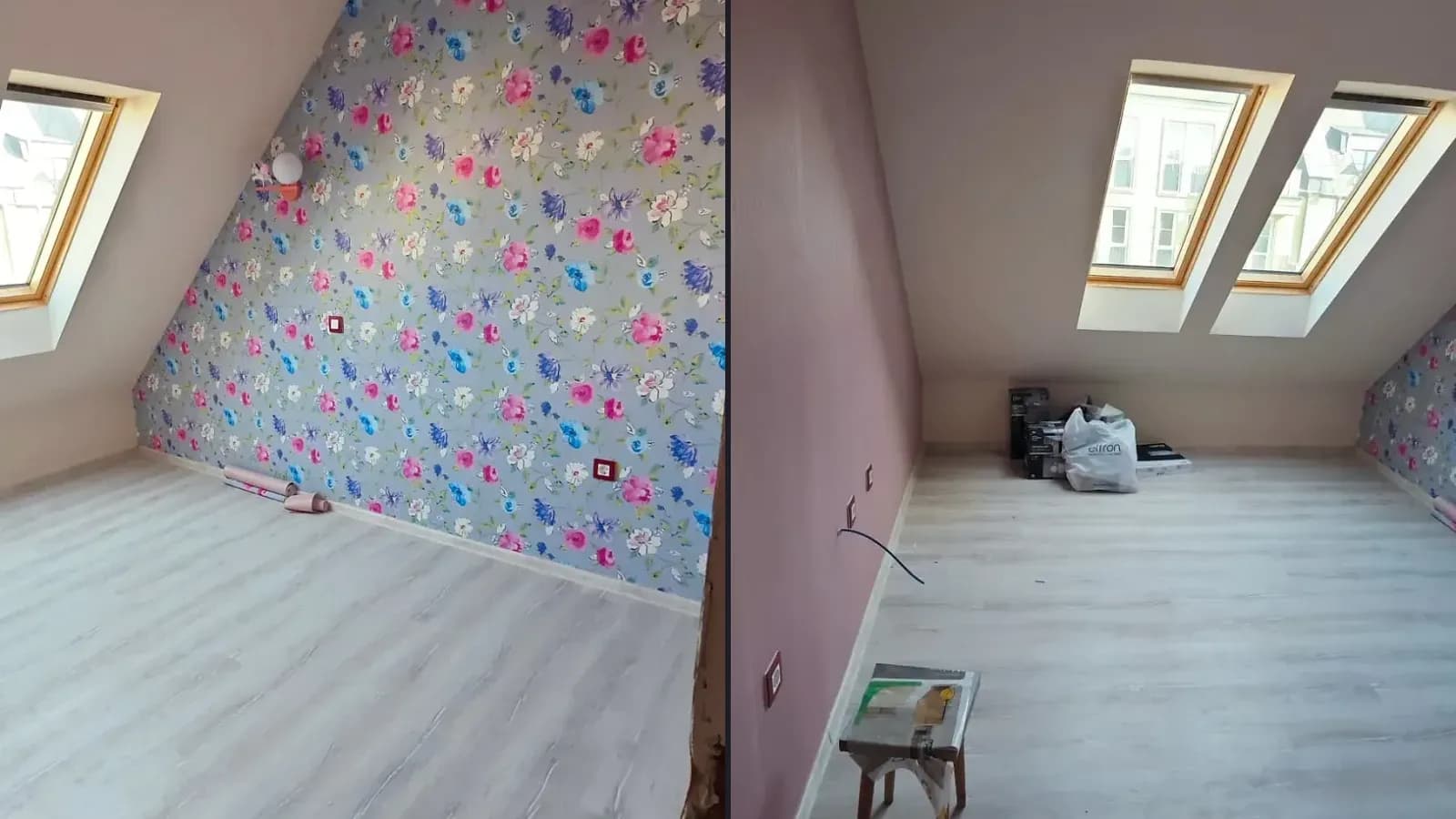 Finishing work
11 min read
Wallpaper hanging: cost per m² and how to prepare the wall
Hanging wallpaper costs €11.00 per m² for labour, stripping it €4.60. What the preparation adds, which wallpaper suits which room and how many rolls.
Read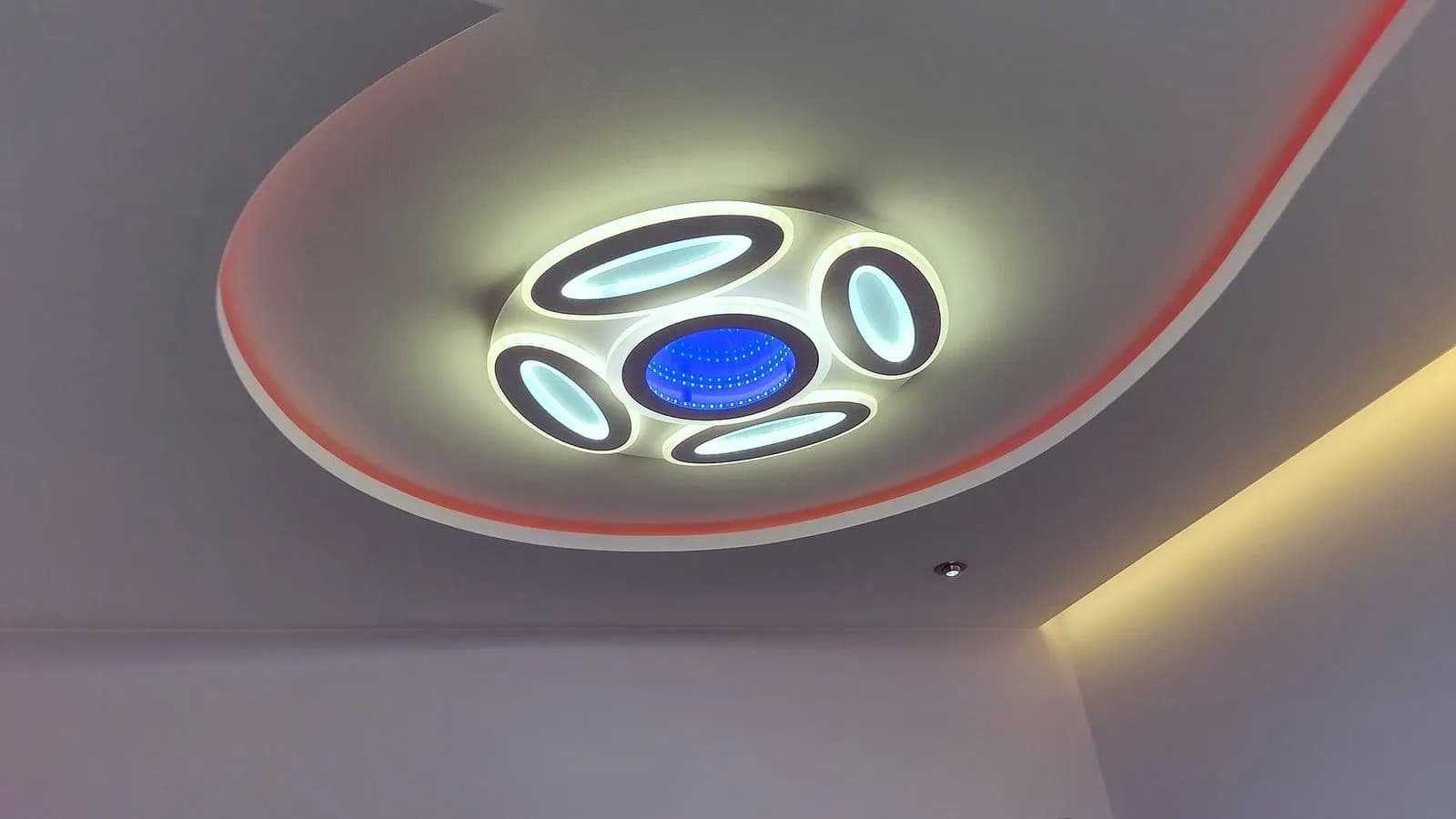 Finishing work
11 min read
Suspended ceiling with LED lighting: types, labour cost and examples
The types of suspended ceiling, what the labour costs and a worked example for a 16 m² room with LED strip and downlights – plus what to decide first.
Read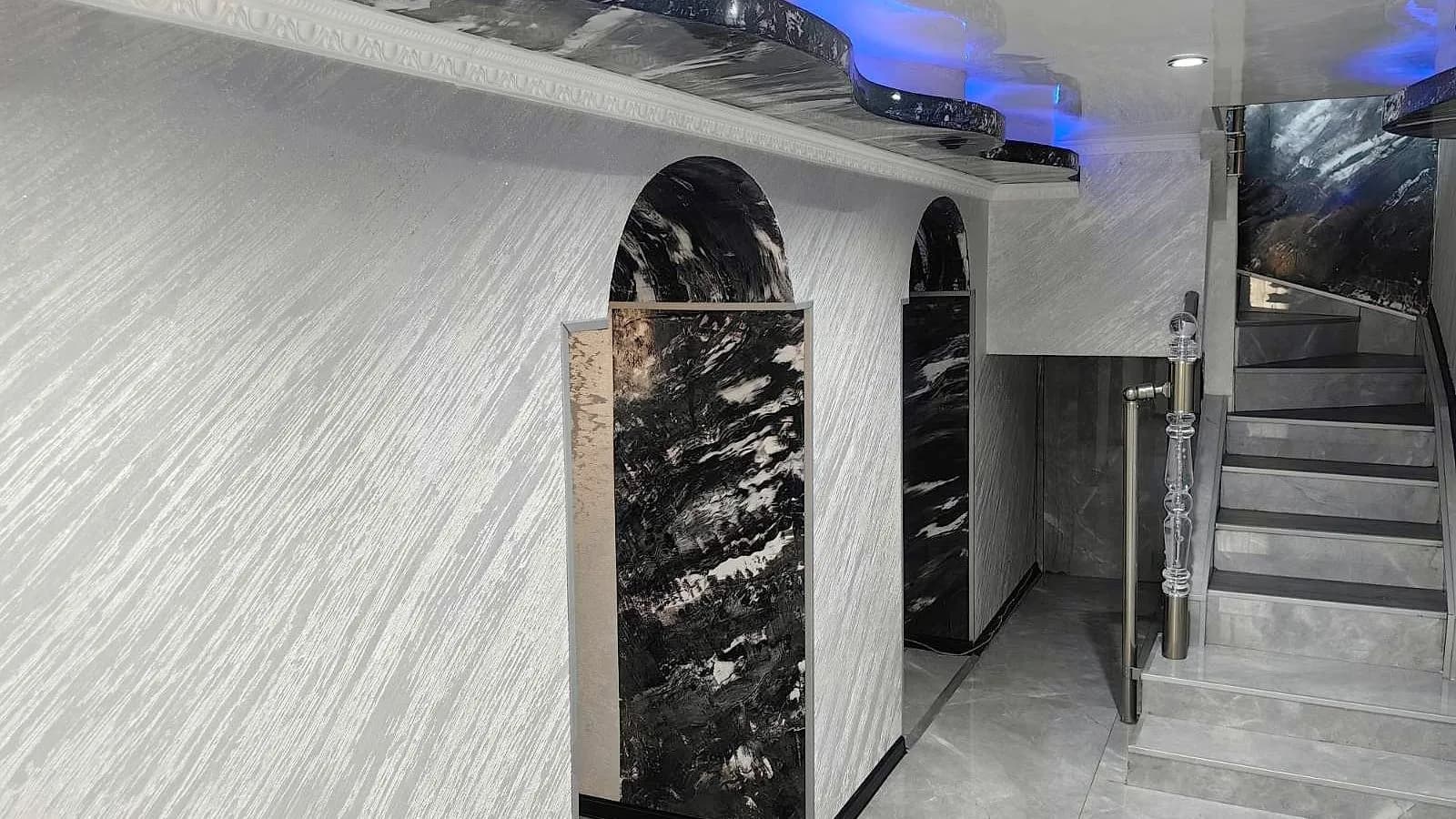 Finishing work
11 min read
Plaster prices 2026 (labour): sand-finish, Venetian, travertine
Labour per m² for gypsum, lime-cement, sand-finish and Venetian plaster and silicone render, what the preparation adds and a worked example.
Read